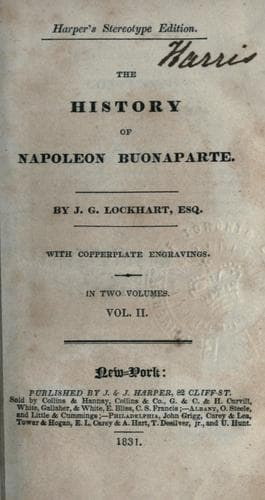
The History of Napoleon BuonaparteLockhart, J. G. (John Gibson)
History
The History of Napoleon Buonaparte
Lockhart, J. G. (John Gibson)
France -- Kings and rulers -- Biography; Napoleon I, Emperor of the French, 1769-1821
disease in its train, to aggravate the sufferings of the townspeople;
but they would listen to no suggestions but those of the same proud
spirit in which they had begun. The French at length gained possession
of the great convent of St. Engracia, and thus established themselves
within the town itself: their general then sent to Palafox this brief
summons: "Headquarters, Santa Engracia--Capitulation"; but he received
for answer: "Headquarters, Zaragossa--War to the knife." The battle was
maintained literally from street to street, from house to house, and
from chamber to chamber. Men and women fought side by side, amidst
flames and carnage; until Lefebre received the news of Baylen, and
having wasted two months in his enterprise, abandoned it abruptly, lest
he should find himself insulated amidst the general retreat of the
French armies. Such was the first of the two famous sieges of Zaragossa.
The English government meanwhile had begun their preparations for
interfering effectually in the affairs of the Peninsula. They had
despatched one body of troops to the support of Castaños in Andalusia;
but these did not reach the south of Spain until their assistance was
rendered unnecessary by the surrender of Dupont at Baylen. A more
considerable force, amounting to 10,000, sailed early in June, from
Cork, for Coruña, under the command of the Honourable Sir Arthur
Wellesley. This armament, originally designed to co-operate with another
from India in a great attack on Mexico, had its destination altered the
moment the Spanish Insurrection was announced. Sir Arthur, being
permitted to land at what point of the Peninsula he should judge most
advantageous for the general cause, was soon satisfied that Portugal
ought to be the first scene of his operations, and accordingly lost no
time in opening a communication with the patriots, who had taken
possession of Oporto. Here the troops which had been designed to aid
Castaños joined him. Thus strengthened, and well informed of the state
of the French armies in Spain, Sir Arthur resolved to effect a landing
and attack Junot while circumstances seemed to indicate no chance of his
being reinforced by Bessieres.
Public-domain text, read in full here on John Shaqi.
Reviews
Reviews
No reviews yet
Be the first to share your thoughts on this work.
Elsewhere in the archive
Join the Discussion
Join the discussion
Sign in to leave a comment or review.
Sign InorCreate an account