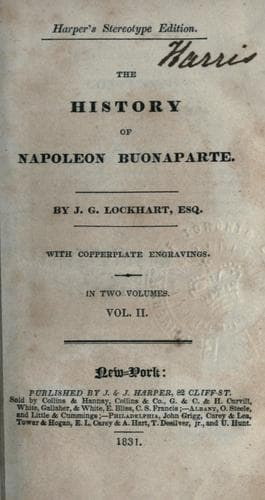
The History of Napoleon BuonaparteLockhart, J. G. (John Gibson)
History
The History of Napoleon Buonaparte
Lockhart, J. G. (John Gibson)
France -- Kings and rulers -- Biography; Napoleon I, Emperor of the French, 1769-1821
It is, perhaps, an evil unavoidable in the institutions of an old and
settled government, that men rarely, very rarely, unless they possess
the advantages of illustrious birth and connection, can hope to be
placed in situations of the highest importance until they have passed
the prime vigour of their days. Sir Arthur Wellesley, fortunately for
England and for Europe, commenced life under circumstances eminently
favourable for the early development and recognition of his great
talents. To his brother, the Marquis Wellesley's rank as
Governor-General of India, he owed the opportunity of conducting our
armies in the East at a time of life when, if of inferior birth, he
could hardly have commanded a battalion; and the magnificent campaign of
Assaye so established his reputation, that shortly after his return to
Europe he was entrusted without hesitation with the armament assembled
at Cork.
It was on the 8th of August, 1808--a day ever memorable in the history
of Britain--that Sir Arthur Wellesley effected his debarkation in the
bay of Mondego. He immediately commenced his march towards Lisbon, and
on the 17th came up with the enemy under General Laborde, strongly
posted on an eminence near Roriça. The French contested their ground
gallantly, but were driven from it at the point of the bayonet, and
compelled to retreat. The British General, having hardly any cavalry,
was unable to pursue them so closely as he otherwise would have done:
and Laborde succeeded in joining his shattered division to the rest of
the French forces in Portugal. Junot (recently created Duke of Abrantes)
now took the command in person; and finding himself at the head of full
24,000 troops, while the English army were greatly inferior in numbers,
and miserably supplied with cavalry and artillery, he did not hesitate
to assume the offensive. On the 21st of August he attacked Sir Arthur at
Vimiero. In the language of the English General's despatch, "a most
desperate contest ensued"; and the result was "a signal defeat," Junot,
having lost thirteen cannon and more than two thousand men, immediately
fell back upon Lisbon, where his position was protected by the strong
defile of the Torres Vedras.
Public-domain text, read in full here on John Shaqi.
Reviews
Reviews
No reviews yet
Be the first to share your thoughts on this work.
Elsewhere in the archive
Join the Discussion
Join the discussion
Sign in to leave a comment or review.
Sign InorCreate an account