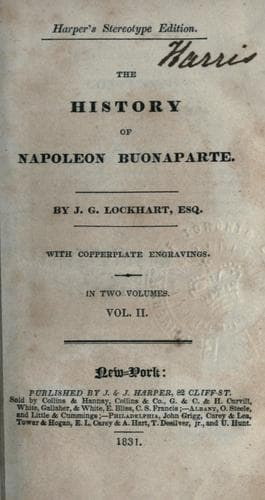
The History of Napoleon BuonaparteLockhart, J. G. (John Gibson)
History
The History of Napoleon Buonaparte
Lockhart, J. G. (John Gibson)
France -- Kings and rulers -- Biography; Napoleon I, Emperor of the French, 1769-1821
Napoleon now saw the main way to Madrid open before him--except that
some forces were said to be posted at the strong defile of the
Somosierra, within ten miles of the capital; while Soult, continuing his
march by Carrion and Valladolid, could at once keep in check the
English, in case they were still so daring as to advance from Portugal,
and outflank the Somosierra, in case the mountains should be so defended
as to bar the Emperor's approach in that direction to Madrid. Palafox
was pursued, and soon shut up in Zaragossa by Lannes. That heroic city
on the east, the British army on the west, and Madrid in front, were the
only far-separated points on which any show of opposition was still to
be traced--from the frontiers of France to those of Portugal, from the
sea coast to the Tagus.
Napoleon, with his guards and the first division, marched towards
Madrid. His vanguard reached the foot of the Somosierra chain on the
30th of November, and found that a corps of 12,000 men had been
assembled for the defence of the pass, under General St. Juan. No
stronger position could well be fancied than that of the Spaniards: the
defile was narrow, and excessively steep, and the road completely swept
by sixteen pieces of artillery. At daybreak, on the 1st of December, the
French began their attempt to turn the flanks of St. Juan: three
battalions scattered themselves over the opposite sides of the defile,
and a warm skirmishing fire had begun. At this moment Buonaparte came
up. He rode into the mouth of the pass, surveyed the scene for an
instant, perceived that his infantry were making no progress, and at
once conceived the daring idea of causing his Polish lancers to charge
right up the causeway in face of the battery. The smoke of the
skirmishers on the hill-sides mingled with the thick fogs and vapours of
the morning, and under this veil the brave Krazinski led his troopers
impetuously up the ascent. The Spanish infantry fired as they passed
them, threw down their arms, abandoned their entrenchments, and fled.
The Poles speared the gunners, and took possession of the cannon. The
Spaniards continued their flight in such disorder that they were at last
fain to quit the road to Madrid, and escape in the direction, some of
Segovia, others of Talaveyra. On the morning of the 2nd, three divisions
of French cavalry made their appearance on the high ground to the
north-west of the capital.
Public-domain text, read in full here on John Shaqi.
Reviews
Reviews
No reviews yet
Be the first to share your thoughts on this work.
Elsewhere in the archive
Join the Discussion
Join the discussion
Sign in to leave a comment or review.
Sign InorCreate an account