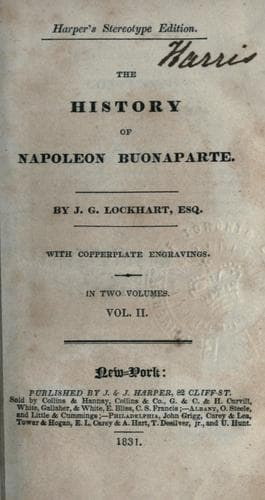
The History of Napoleon BuonaparteLockhart, J. G. (John Gibson)
History
The History of Napoleon Buonaparte
Lockhart, J. G. (John Gibson)
France -- Kings and rulers -- Biography; Napoleon I, Emperor of the French, 1769-1821
supposed to fancy that even on one point, he had the better of his
master.
The disgrace of Fouché was certainly a very unpopular measure. The
immediate cause of it could not be divulged, and the minister was
considered as having fallen a sacrifice to the honesty of his
remonstrances on the Spanish invasion and the increased rigour of the
Emperor's domestic administration. It was about this time that, in
addition to the castle of Vincennes, nine new state-prisons were
established in France; and the number of persons confined in these
receptacles, on warrants signed by the Emperor and his slavish privy
council, far exceeded those condemned to similar usage in any recent
period of the Bourbon monarchy, under the _lettres de cachet_ of the
sovereign. These were proofs, not to be mistaken, of the growth of
political disaffection. In truth the "continental system," the terrible
waste of life occasioned by the late campaigns in Poland and Austria,
and the constant demands, both on the treasure and the blood of France,
rendered necessary by the apparently interminable war in the
Peninsula--these were evils which could not exist without alienating the
hearts of the people. The police filled the ears of the Emperor with
reports of men's private conversation. Citizens were daily removed from
their families, and buried in remote and inaccessible dungeons, for no
reason but that they had dared to speak what the immense majority of
their neighbours thought. His quarrels with Lucien, who had contracted a
marriage unsuitable, in the Emperor's opinion, to his rank, were so
indecently violent, that that ablest of his brothers at length sought a
refuge in England, where he remained during several years. The total
slavery of the press, its audacious lies, and more audacious silence,
insulted the common sense of all men. Disaffection was secretly, but
rapidly, eating into the heart of his power; and yet, as if blinded to
all consequences by some angry infliction of heaven, the irritable
ambition of Napoleon was already tempting another great foreign enemy
into the field.
Public-domain text, read in full here on John Shaqi.
Reviews
Reviews
No reviews yet
Be the first to share your thoughts on this work.
Elsewhere in the archive
Join the Discussion
Join the discussion
Sign in to leave a comment or review.
Sign InorCreate an account