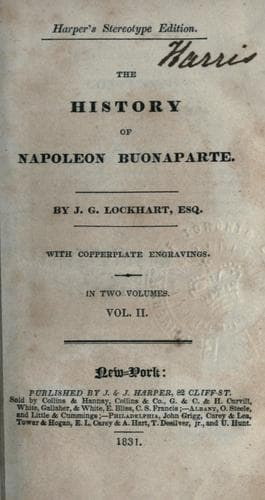
The History of Napoleon BuonaparteLockhart, J. G. (John Gibson)
History
The History of Napoleon Buonaparte
Lockhart, J. G. (John Gibson)
France -- Kings and rulers -- Biography; Napoleon I, Emperor of the French, 1769-1821
It was indeed, terrible to the enemy. It deprived them of another
excellent line of defence, and blew up the enthusiasm of the French
soldiery to a pitch of irresistible daring. Beaulieu, nevertheless,
contrived to withdraw his troops in much better style than Buonaparte
had anticipated. He gathered the scattered fragments of his force
together, and soon threw the line of the Mincio, another tributary of
the Po, between himself and his enemy. The great object, however, had
been attained: the Austrian general escaped, and might yet defend
Mantua, but no obstacle remained between the victorious invader and the
rich and noble capital of Lombardy. The garrison of Pizzighitone, seeing
themselves effectually cut off from the Austrian army, capitulated. The
French cavalry pursued Beaulieu as far as Cremona, which town they
seized; and Napoleon himself prepared to march at once upon Milan.
It was after one of these affairs that an old Hungarian officer was
brought prisoner to Buonaparte, who entered into conversation with him,
and among other matters questioned him "what he thought of the state of
the war?" "Nothing," replied the old gentleman, who did not know he was
addressing the general-in-chief,--"nothing can be worse. Here is a young
man who knows absolutely nothing of the rules of war; to-day he is in
our rear, to-morrow on our flank, next day again in our front. Such
violations of the principles of the art of war are intolerable!"
The Archduke, who governed in Lombardy for the Emperor, had made many a
long prayer and procession; but the saints appeared to take no
compassion on him, and he now withdrew from the capital. A revolutionary
party had always existed there, as indeed in every part of the Austrian
dominions beyond the Alps; and the tricolor cockade, the emblem of
France, was now mounted by multitudes of the inhabitants. The
municipality hastened to invite the conqueror to appear among them as
their friend and protector; and on the 14th of May, four days after
Lodi, Napoleon accordingly entered, in all the splendour of a military
triumph, the venerable and opulent city of the old Lombard kings.
He was not, however, to be flattered into the conduct, as to serious
matters, of a friendly general. He levied immediately a heavy
contribution (eight hundred thousand pounds sterling) at Milan,--taking
possession, besides, of twenty of the finest pictures in the Ambrosian
gallery.
Public-domain text, read in full here on John Shaqi.
Reviews
Reviews
No reviews yet
Be the first to share your thoughts on this work.
Join the Discussion
Join the discussion
Sign in to leave a comment or review.
Sign InorCreate an account