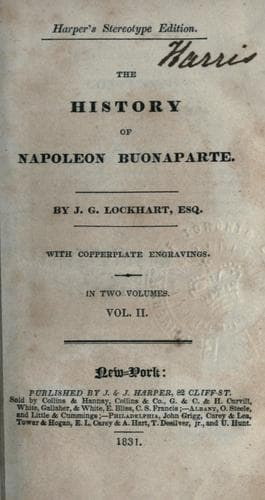
The History of Napoleon BuonaparteLockhart, J. G. (John Gibson)
History
The History of Napoleon Buonaparte
Lockhart, J. G. (John Gibson)
France -- Kings and rulers -- Biography; Napoleon I, Emperor of the French, 1769-1821
The conqueror now paused to look about and behind him; and proceeded
still farther to replenish his chest by exactions, for which no
justification can be adduced from the ordinary rules of international
law. With Sardinia he had already reckoned; of the Austrian capital in
Italy he had possession; there was only one more of the Italian
governments (Naples) with which the French Republic was actually at war;
although, indeed, he had never concealed his intention of revenging the
fate of Basseville on the court of Rome. The other powers of Italy were,
at worst, neutrals; with Tuscany and Venice, France had friendly
relations. But Napoleon knew or believed, that all the Italian
governments, without exception, considered the French invasion of Italy
as a common calamity; the personal wishes of most of the minor princes
(nearly connected as these were, by blood or alliance, with the imperial
house of Austria) he, not unreasonably, concluded were strongly against
his own success in this great enterprise. Such were his pretences--more
or less feasible; the temptation was, in fact, great; and he resolved to
consider and treat whatever had not been with him as if it had been
against him. The weak but wealthy princes of Parma and Modena, and
others of the same order, were forthwith compelled to purchase his
clemency not less dearly than if they had been in arms. Besides money,
of which he made them disburse large sums, he demanded from each a
tribute of pictures and statues, to be selected at the discretion of
Citizen Monge and other French connoisseurs, who now attended his march
for such purposes.
In modern warfare the works of art had hitherto been considered as a
species of property entitled in all cases to be held sacred; and
Buonaparte's violent and rapacious infraction of this rule now excited a
mighty clamour throughout Europe. Whether the new system originated with
himself, or in the commands of the Directory, is doubtful. But from this
time the formation of a great national gallery of pictures and statues
at Paris was considered as an object of the first importance; and every
victorious general was expected to bring trophies of this kind in his
train. Whether the fine arts themselves are likely to be improved in
consequence of the accumulation in any one place of such vast treasures
as the Louvre were long exhibited, there has been, and will no doubt
continue to be, much controversy. It is certain that the arts of France
derived no solid advantage from Napoleon's museum. The collection was a
mighty heap of incense for the benefit of the national vanity; and the
hand which brought it together was preparing the means of inflicting on
that vanity one of the most intolerable of wounds, in its ultimate
dispersion.
Public-domain text, read in full here on John Shaqi.
Reviews
Reviews
No reviews yet
Be the first to share your thoughts on this work.
Join the Discussion
Join the discussion
Sign in to leave a comment or review.
Sign InorCreate an account