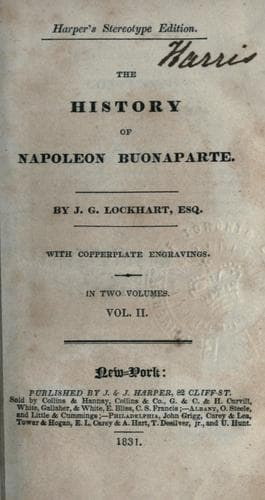
The History of Napoleon BuonaparteLockhart, J. G. (John Gibson)
History
The History of Napoleon Buonaparte
Lockhart, J. G. (John Gibson)
France -- Kings and rulers -- Biography; Napoleon I, Emperor of the French, 1769-1821
Napoleon, having done whatever lay in his power to remedy the disorders
of his commissariat--and this, after all, does not appear to have been
much--at length reappeared in the field. He had now determined to make
St. Petersburg his mark: he counted much on the effects which a
triumphal entry into the capital would produce throughout the country;
and the fleet at Cronstadt was in itself a prize of the utmost
importance. He directed, therefore, all his efforts towards the Dwina,
where the Russian commander-in-chief had now halted on extensive
intrenchments, and Riga. This town, however, was now defended, not only
by Essen, but by the English sailors of Admiral Martin's fleet, and
resisted effectually; and, to the confusion of Napoleon, he was repelled
in three successive attempts to force Barclay's camp at Dunaburg.
He upon this changed his plan of operations, and resolving to march, not
for Petersburg, but for Moscow, threw forward the centre of his army,
under Davoust, with the view of turning Barclay's position, and cutting
off his communications with Bagrathion. That general was compelled by
this movement to pass the Dnieper (or Borysthenes); and Barclay, on
perceiving the object of Davoust's march, broke up from the camp on the
Dwina, and retired upon Vitepsk, where he hoped to be joined by
Bagrathion. Davoust, however, brought Bagrathion to action near Mohilow,
on the 23rd of July; and as the French remained in possession of that
town at the end of the day, the Russians found themselves under the
necessity of altering the line of their retreat. Bagrathion informed
Barclay that he was now marching, not on Vitepsk, but on Smolensko, and
the commander-in-chief felt the necessity of abandoning Vitepsk also.
During three days (the 25th, 26th, and 27th of July), his troops were
engaged with the French at Vitepsk; and, though Napoleon's bulletins
announced three splendid victories, the result was that the Russians
left their position in admirable order, and retired altogether
unmolested on the proposed point of junction. Meantime Regnier, on the
right wing, and Oudinot, on the left, were defeated; the former by
Tormazoff, the latter by Witgenstein, both with severe loss. The Emperor
halted at Vitepsk for several days; "his troops," as the bulletins
admitted, "requiring refreshment." The Russian plan of defence was
already ascertained--and alarming. The country was laid utterly desolate
wherever they retired; every village was burned ere they quitted it: the
enthusiastic peasantry withdrew with the army and swelled its ranks.
Public-domain text, read in full here on John Shaqi.
Reviews
Reviews
No reviews yet
Be the first to share your thoughts on this work.
Elsewhere in the archive
Join the Discussion
Join the discussion
Sign in to leave a comment or review.
Sign InorCreate an account