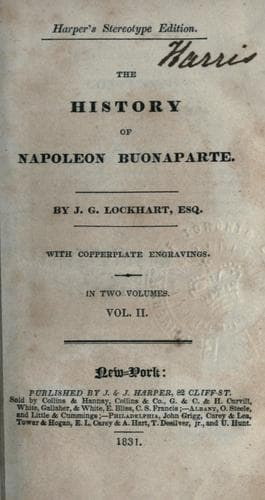
The History of Napoleon BuonaparteLockhart, J. G. (John Gibson)
History
The History of Napoleon Buonaparte
Lockhart, J. G. (John Gibson)
France -- Kings and rulers -- Biography; Napoleon I, Emperor of the French, 1769-1821
Napoleon quitted Vitepsk on the 8th of August, and after a partial
engagement at Krasnoi on the 14th, came in sight of Smolensko, on the
16th. The first and second armies of the Czar (Bagrathion having at
length effected his junction with Barclay), lay behind the river which
flows at the back of this town; but it was occupied in great force.
Three times did Buonaparte attack it, and three times he was repulsed.
During the night the garrison withdrew, and joined the army across the
river--but before they went they committed the city to the flames, and,
the buildings being chiefly of wood, the conflagration, according to the
French bulletin, "resembled in its fury an eruption of Vesuvius."
"Never" (continues the same bulletin) "was war conducted with such
inhumanity: the Russians treat their own country as if it were that of
an enemy." Such was indeed their resolution. They had no desire that the
invader should establish himself in winter quarters at Smolensko. With
the exception of some trivial skirmishes, they retreated unmolested from
Smolensko to Dorogobuz, and thence on Viasma; halting at each of these
towns, and deliberately burning them in the face of the enemy.
It now, however, began to be difficult in the extreme to prevail on the
Russian soldiery to continue their retreat. They had consented to retire
in the beginning solely because they were assured that such was the will
of their _Father_--as they affectionately call their sovereign; but
reinforcements were now joining them daily from the interior, and the
skirmishes which had occurred had so inflamed their spirits, that it
seemed impossible to restrain them much longer. At this period also,
Barclay was appointed to the war-ministry at St. Petersburg, and
Kutusoff, who assumed the command in his stead, was supposed to doubt
whether the system of retreat had not been far enough persisted in. The
new general at length resolved to comply with the clamorous entreaties
of his troops, and fixed on a strong position between Borodino and
Moskwa, on the high road to Moscow, where he determined to await the
attack of Napoleon. It was at Gjatz that the Emperor was informed of
Kutusoff's arrival, and of the universal belief that the Czar had at
length consented to run the hazard of a great battle. A little further
on a Russian officer, on some pretext, appeared with a flag of truce;
his real errand being, no doubt, to witness the state of the invader's
camp. Being brought into Napoleon's presence this man was asked, "What
he should find between Viasma and Moscow?" He answered, "Pultowa."
Public-domain text, read in full here on John Shaqi.
Reviews
Reviews
No reviews yet
Be the first to share your thoughts on this work.
Elsewhere in the archive
Join the Discussion
Join the discussion
Sign in to leave a comment or review.
Sign InorCreate an account