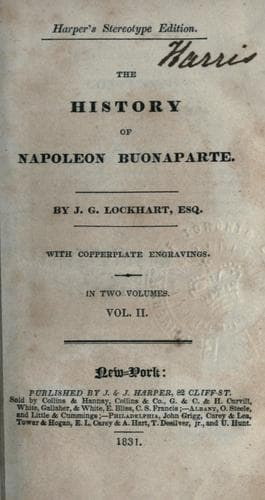
The History of Napoleon BuonaparteLockhart, J. G. (John Gibson)
History
The History of Napoleon Buonaparte
Lockhart, J. G. (John Gibson)
France -- Kings and rulers -- Biography; Napoleon I, Emperor of the French, 1769-1821
On the 5th of September, Napoleon came in sight of the position of
Kutusoff, and succeeded in carrying a redoubt in front of it. All the
6th the two armies lay in presence of each other, preparing for the
contest. The Russians were posted on an elevated plain; having a wood on
their right flank, their left on one of the villages, and a deep ravine,
the bed of a small stream, in their front. Extensive field-works covered
every more accessible point of this naturally very strong ground; and in
the centre of the whole line, a gentle eminence was crowned by an
enormous battery, serving as a species of citadel. The Russian army were
120,000 in numbers; nor had Napoleon a greater force in readiness for
his attack. In artillery also the armies were equal. It is supposed that
each had 500 guns in the field. Buonaparte addressed his troops in his
usual style of language: "Soldiers! here is the battle you have longed
for; it is necessary, for it brings us plenty, good winter-quarters, and
a safe return to France. Behave yourselves so that posterity may say of
each of you, _He was in that great battle beneath the walls of Moscow._"
In the Russian camp, meanwhile, the clergy appeared in their richest
vestments, and displaying their holiest images, called on the men to
merit Paradise by devoting themselves in the cause of their country. The
soldiers answered with shouts which were audible throughout all the
enemy's lines.
At four o'clock in the morning of the 7th, the French advanced under
cover of a thick fog, and assaulted at once the centre, the right, and
the left of the position. Such was the impetuosity of the charge that
they drove the Russians from their redoubts; but this was but for a
moment. They rallied under the very line of their enemy's fire, and
instantly re-advanced. Peasants who, till that hour, had never seen war,
and who still wore their usual rustic dress, distinguished only by a
cross sewed on it in front, threw themselves into the thickest of the
combat. As they fell, others rushed on and filled their places. Some
idea may be formed of the obstinacy of the contest from the fact, that
of one division of the Russians which mustered 30,000 in the morning,
only 8000 survived. These men had fought in close order, and unshaken,
under the fire of eighty pieces of artillery. The result of this
terrible day was, that Buonaparte withdrew his troops and abandoned all
hope of forcing his way through the Russians. In no contest by many
degrees so desperate had he hitherto been engaged. Night found either
army on the ground they had occupied at daybreak. The number of guns and
prisoners taken by the French and the Russians was about equal; and of
either host there had fallen not less than 40,000 men. Some accounts
raise the gross number of the slain to 100,000. Such was the victory in
honour of which Napoleon created Marshal Ney _Prince of Moskwa_.
Public-domain text, read in full here on John Shaqi.
Reviews
Reviews
No reviews yet
Be the first to share your thoughts on this work.
Elsewhere in the archive
Join the Discussion
Join the discussion
Sign in to leave a comment or review.
Sign InorCreate an account