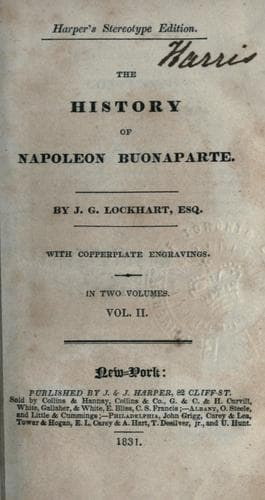
The History of Napoleon BuonaparteLockhart, J. G. (John Gibson)
History
The History of Napoleon Buonaparte
Lockhart, J. G. (John Gibson)
France -- Kings and rulers -- Biography; Napoleon I, Emperor of the French, 1769-1821
Another unlooked-for occurrence delayed, for a few days longer, the
march upon Mantua. The heavy exactions of the French, and even more
perhaps the wanton contempt with which they treated the churches and the
clergy, had produced or fostered the indignation of a large part of the
population throughout Lombardy. Reports of new Austrian levies being
poured down the passes of the Tyrol were spread and believed. Popular
insurrections against the conqueror took place in various districts: at
least 30,000 were in arms. At Pavia the insurgents were entirely
triumphant; they had seized the town, and compelled the French garrison
to surrender.
This flame, had it been suffered to spread, threatened immeasurable evil
to the French cause. Lannes instantly marched to Benasco, stormed the
place, plundered and burnt it, and put the inhabitants to the sword
without mercy. The general in person appeared before Pavia; blew the
gates open; easily scattered the townspeople; and caused the leaders to
be executed, as if they had committed a crime in endeavouring to rescue
their country from the arm of a foreign invader. Everywhere the same
ferocious system was acted on. The insurgent commanders were tried by
courts-martial, and shot without ceremony. At Lugo, where a French
squadron of horse had been gallantly and disastrously defeated, the
whole of the male inhabitants were massacred. These bloody examples
quelled the insurrections; but they fixed the first dark and indelible
stain on the name of Napoleon Buonaparte.
The spirit of the Austrian and Catholic parties in Lombardy thus
crushed, the French advanced on the Mincio. The general made such
disposition of his troops, that Beaulieu doubted not he meant to pass
that river, if he could, at Peschiera. Meantime he had been preparing to
repeat the scene of Placenza;--and actually, on the 30th of May, forced
the passage of the Mincio, not at Peschiera, but further down at
Borghetto. The Austrian garrison at Borghetto in vain destroyed one arch
of the bridge. Buonaparte supplied the breach with planks; and his men,
flushed with so many victories, charged with a fury not to be resisted.
Beaulieu was obliged to abandon the Mincio, as he had before the Adda
and the Po, and to take up the new line of the Adige.
Public-domain text, read in full here on John Shaqi.
Reviews
Reviews
No reviews yet
Be the first to share your thoughts on this work.
Join the Discussion
Join the discussion
Sign in to leave a comment or review.
Sign InorCreate an account