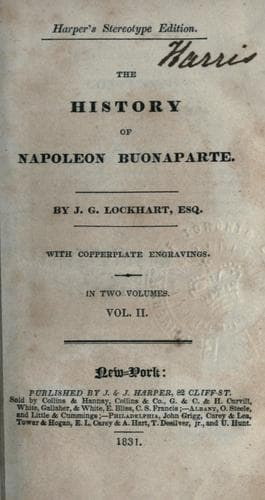
The History of Napoleon BuonaparteLockhart, J. G. (John Gibson)
History
The History of Napoleon Buonaparte
Lockhart, J. G. (John Gibson)
France -- Kings and rulers -- Biography; Napoleon I, Emperor of the French, 1769-1821
The Duke of Modena would fain have redeemed the famous St. Jerome, of
Correggio, at the price of £80,000; and Buonaparte's lieutenants urged
him to accept the money. "No," said he, "the duke's two millions of
francs would soon be spent; but his Correggio will remain for ages to
adorn Paris, and inspire the arts of France." The prophecy was not
inspired. Of one thing there can be no doubt; namely, that the
abstraction of these precious monuments of art from the Italian
collections was deeply and permanently resented by the Italian people.
This sacrilege, as those enthusiastic and intelligent lovers of all the
elegant arts considered it, turned back many a half-made convert from
the principles of the French Revolution.
Buonaparte remained but five days in Milan; the citadel of that place
still held out against him; but he left a detachment to blockade it, and
proceeded himself in pursuit of Beaulieu. The Austrian had now planted
the remains of his army behind the Mincio, having his left on the great
and strong city of Mantua, which has been termed "the citadel of Italy,"
and his right at Peschiera a Venetian fortress, of which he took
possession in spite of the remonstrances of the Doge. Peschiera stands
where the Mincio flows out of "its parent lake," the Lago di Guarda.
That great body of waters, stretching many miles backwards towards the
Tyrolese Alps, at once extended the line of defence, and kept the
communication open with Vienna. The Austrian veteran occupied one of the
strongest positions that it is possible to imagine. The invader hastened
once more to dislodge him.
The French Directory, meanwhile, had begun to entertain certain not
unnatural suspicions as to the ultimate designs of their young general,
whose success and fame had already reached so astonishing a height. They
determined to check, if they could, the career of an ambition which they
apprehended might outgrow their control. Buonaparte was ordered to take
half his army, and lead it against the Pope and the King of Naples, and
leave the other half to terminate the contest with Beaulieu, under the
orders of Kellerman. But he acted on this occasion with the decision
which these Directors in vain desired to emulate. He answered by
resigning his command. "One half of the army of Italy," said he, "cannot
suffice to finish the matter with the Austrian. It is only by keeping my
force entire that I have been able to gain so many battles and to be now
in Milan. You had better have one bad general than two good ones." The
Directory durst not persist in displacing the chief whose name was
considered as the pledge of victory. Napoleon resumed the undivided
command, to which now, for the last time, his right had been questioned.
Public-domain text, read in full here on John Shaqi.
Reviews
Reviews
No reviews yet
Be the first to share your thoughts on this work.
Join the Discussion
Join the discussion
Sign in to leave a comment or review.
Sign InorCreate an account