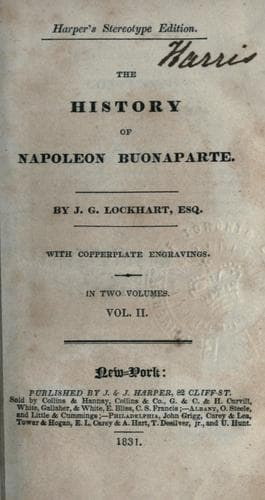
The History of Napoleon BuonaparteLockhart, J. G. (John Gibson)
History
The History of Napoleon Buonaparte
Lockhart, J. G. (John Gibson)
France -- Kings and rulers -- Biography; Napoleon I, Emperor of the French, 1769-1821
Mantua lies on an island, being cut off on all sides from the main land
by the branches of the Mincio, and approachable only by five narrow
causeways, of which three were defended by strong and regular fortresses
or entrenched camps, the other two by gates, drawbridges, and batteries.
Situated amidst stagnant waters and morasses, its air is pestilential,
especially to strangers. The garrison were prepared to maintain the
position with their usual bravery; and it remained to be seen whether
the French general possessed any new system of attack, capable of
abridging the usual operations of the siege, as effectually as he had
already done by those of the march and the battle. His commencement was
alarming: of the five causeways, by sudden and overwhelming assaults, he
obtained four; and the garrison were cut off from the main land, except
only at the fifth causeway, the strongest of them all, named, from a
palace near it, _La Favorita_. It seemed necessary, however, in order
that this blockade might be complete, that the Venetian territory, lying
immediately beyond Mantua, should be occupied by the French. The power
of this ancient government was no longer such as to inspire much
respect, and Buonaparte resolved that the claim of neutrality should
form no obstacle to his measures. The French Directory had already most
ungenerously trampled on the dignity of Venice, by demanding that she
should no longer afford a retreat to the illustrious exile, the Count of
Provence, eldest surviving brother of Louis XVI.[9] That unfortunate
prince had, accordingly, though most reluctantly, been desired to quit
the Venetian states, and had already passed to the Rhine, where his
gallant cousin, the Prince of Condé, had long been at the head of a
small and devoted army composed of the expatriated gentry of France.
Buonaparte, however, chose to treat the reluctance with which Venice had
been driven to this violation of her hospitality, as a new injury to his
government: he argued that a power who had harboured in friendship, and
unwillingly expelled, the _Pretender_ to the French monarchy, had lost
all title to forbearance on the part of the Revolutionary forces. This
was a gross and ungenerous insult, and it was a gratuitous one; for he
had a far better argument behind. The imperial general had, as we have
seen, neglected the reclamations of the Doge, when it suited his purpose
to occupy Peschiera. "You are too weak," said Buonaparte, when the
Venetian envoy reached his headquarters, "to enforce neutrality on
hostile nations such as France and Austria. Beaulieu did not respect
your territory when his interest bade him violate it; nor shall I
hesitate to occupy whatever falls within the line of the Adige." In
effect, garrisons were placed forthwith in Verona, and all the strong
places of that domain. The tricolor flag now waved at the mouth of the
Tyrolese passes; and Napoleon, leaving Serrurier to blockade Mantua,
Public-domain text, read in full here on John Shaqi.
Reviews
Reviews
No reviews yet
Be the first to share your thoughts on this work.
Join the Discussion
Join the discussion
Sign in to leave a comment or review.
Sign InorCreate an account