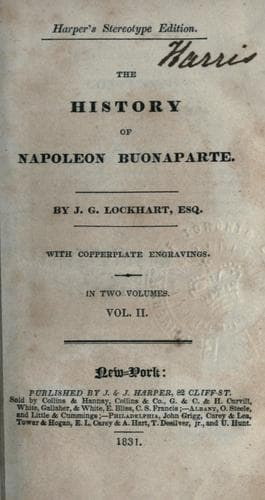
The History of Napoleon BuonaparteLockhart, J. G. (John Gibson)
History
The History of Napoleon Buonaparte
Lockhart, J. G. (John Gibson)
France -- Kings and rulers -- Biography; Napoleon I, Emperor of the French, 1769-1821
returned to Milan, where he had important business to arrange.
The King of Naples, utterly confounded by the successes of the French,
was now anxious to procure peace, almost on whatever terms, with the
apparently irresistible Republic. Nor did it, for the moment, suit
Buonaparte's views to contemn his advances. A peace with this prince
would withdraw some valuable divisions from the army of Beaulieu; and
the distance of the Neapolitan territory was such, that the French had
no means of carrying the war thither with advantage, so long as Austria
retained the power of sending new forces into Italy by the way of the
Tyrol. He concluded an armistice accordingly, which was soon followed by
a formal peace, with the King of the Two Sicilies; and the Neapolitan
troops, who had recently behaved with eminent gallantry, abandoning the
Austrian general, began their march to the south of Italy.
This transaction placed another of Napoleon's destined victims entirely
within his grasp. With no friend behind him, the Pope saw himself at the
mercy of the invader; and in terror prepared to submit. Buonaparte
occupied immediately his legations of Bologna and Ferrara, making
prisoners in the latter of these towns four hundred of the papal troops,
and a cardinal, under whose orders they were. The churchman militant was
dismissed on parole; but, being recalled to headquarters, answered that
his master, the Pope, had given him a dispensation to break his promise.
This exercise of the old dispensing power excited the merriment of the
conquerors. The Vatican, meanwhile, perceived that no time was to be
lost. The Spanish resident at the Roman court was despatched to Milan;
and the terms on which the holy father was to obtain a brief respite
were at length arranged. Buonaparte demanded and obtained a million
sterling, a hundred of the finest pictures and statues in the papal
gallery, a large supply of military stores, and the cession of Ancona,
Ferrara, and Bologna, with their respective domains.
Public-domain text, read in full here on John Shaqi.
Reviews
Reviews
No reviews yet
Be the first to share your thoughts on this work.
Join the Discussion
Join the discussion
Sign in to leave a comment or review.
Sign InorCreate an account