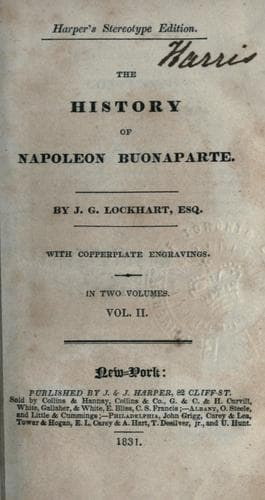
The History of Napoleon BuonaparteLockhart, J. G. (John Gibson)
History
The History of Napoleon Buonaparte
Lockhart, J. G. (John Gibson)
France -- Kings and rulers -- Biography; Napoleon I, Emperor of the French, 1769-1821
The consequences of thus weakening the Austrian force on the Rhine were,
for the moment, on that scene of the contest, inauspicious. The French,
in two separate bodies, forced the passage of the Rhine--under Jourdan
and Moreau; before whom the imperial generals, Wartensleben and the
Archduke Charles, were compelled to retire. But the skill of the
Archduke ere long enabled him to effect a junction with the columns of
Wartensleben; and thus to fall upon Jourdan with a great superiority of
numbers, and give him a signal defeat. The loss of the French in the
field was great, and the bitter hostility of the German peasantry made
their retreat a bloody one. Moreau, on the other hand, learning how
Jourdan was discomfited, found himself compelled to give up the plan of
pursuing his march further into Germany, and executed that famous
retreat through the Black Forest which has made his name as splendid as
any victory in the field could have done. But this reverse, however
alleviated by the honours of Moreau's achievement, was attended with
appearances of the most perilous kind. The genius of Carnot had devised
a great scheme of operations, of which one half was thus at once cut
short. He had meant Moreau and Jourdan, coalescing beyond the Rhine, to
march upon the Tyrol; while Buonaparte should advance from the scene of
his Italian conquests, join his brother generals on that frontier, and
then march in union with them to dictate a peace before the gates of
Vienna. All hope of this junction of forces was now at an end for this
campaign. The French saw themselves compelled to resume the defensive on
the western frontier of Germany; and the army of Italy had to await the
overwhelming war which seemed ready to pour down upon Lombardy from the
passes of the Tyrol.
Wurmser, when he fixed his headquarters at Trent, mustered in all
80,000; while Buonaparte had but 30,000, to hold a wide country, in
which abhorrence of the French cause was now prevalent, to keep up the
blockade of Mantua, and to oppose this fearful odds of numbers in the
field. He was now, moreover, to act on the defensive, while his
adversary assumed the more inspiriting character of invader. He awaited
the result with calmness.
Public-domain text, read in full here on John Shaqi.
Reviews
Reviews
No reviews yet
Be the first to share your thoughts on this work.
Join the Discussion
Join the discussion
Sign in to leave a comment or review.
Sign InorCreate an account