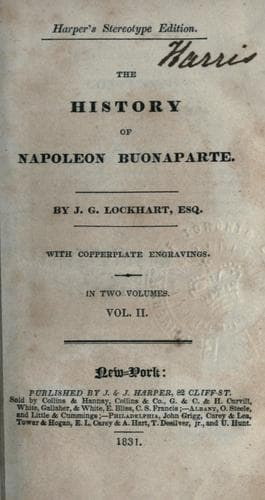
The History of Napoleon BuonaparteLockhart, J. G. (John Gibson)
History
The History of Napoleon Buonaparte
Lockhart, J. G. (John Gibson)
France -- Kings and rulers -- Biography; Napoleon I, Emperor of the French, 1769-1821
Wurmser might have learned from the successes of Buonaparte the
advantages of compact movement; yet he was unwise enough to divide his
great force into three separate columns, and to place one of these upon
a line of march which entirely separated it from the support of the
others. He himself, with his centre, came down on the left bank of the
Lago di Guarda, with Mantua before him as his mark: his left wing, under
Melas, was to descend the Adige, and drive the French from Verona; while
the right wing, under Quasdonowich, were ordered to keep down the valley
of the Chiese, in the direction of Brescia, and so to cut off the
retreat of Buonaparte upon the Milanese;--in other words, to interpose
the waters of the Lago di Guarda between themselves and the march of
their friends--a blunder not likely to escape the eagle eye of Napoleon.
He immediately determined to march against Quasdonowich, and fight him
where he could not be supported by the other two columns. This could
not be done without abandoning for the time the blockade of Mantua; but
it was not for Buonaparte to hesitate about purchasing a great ultimate
advantage by a present sacrifice, however disagreeable. The guns were
buried in the trenches during the night of the 31st July, and the French
quitted the place with a precipitation which the advancing Austrians
considered as the result of terror.
Napoleon meanwhile rushed against Quasdonowich, who had already come
near the bottom of the Lake of Guarda. At Salo, close by the lake, and,
further from it, at Lonato, two divisions of the Austrian column were
attacked and overwhelmed. Augereau and Massena, leaving merely
rear-guards at Borghetto and Peschiera, now marched also upon Brescia.
The whole force of Quasdonowich must inevitably have been ruined by
these combinations, had he stood his ground; but by this time the
celerity of Napoleon had overawed him, and he was already in full
retreat upon his old quarters in the Tyrol. Augereau and Massena,
therefore, countermarched their columns, and returned towards the
Mincio. They found that Wurmser had forced their rear-guards from their
posts: that of Massena, under Pigeon, had retired in good order to
Lonato; that of Augereau, under Vallette, had retreated in confusion,
abandoning Castiglione to the Austrians.
Public-domain text, read in full here on John Shaqi.
Reviews
Reviews
No reviews yet
Be the first to share your thoughts on this work.
Join the Discussion
Join the discussion
Sign in to leave a comment or review.
Sign InorCreate an account