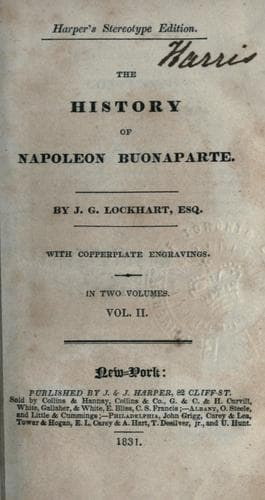
The History of Napoleon BuonaparteLockhart, J. G. (John Gibson)
History
The History of Napoleon Buonaparte
Lockhart, J. G. (John Gibson)
France -- Kings and rulers -- Biography; Napoleon I, Emperor of the French, 1769-1821
Wurmser collected together the whole of his remaining force, and
advanced to meet the conqueror. He, meanwhile, had himself determined on
the assault, and was hastening to the encounter. They met between Lonato
and Castiglione. Wurmser was totally defeated, and narrowly escaped
being a prisoner; nor did he without great difficulty regain Trent and
Roveredo, those frontier positions from which his noble army had so
recently descended with all the confidence of conquerors. In this
disastrous campaign the Austrians lost 40,000: Buonaparte probably
understated his own loss at 7000. During the seven days which the
campaign occupied he never took off his boots, nor slept except by
starts. The exertions which so rapidly achieved this signal triumph were
such as to demand some repose; yet Napoleon did not pause until he saw
Mantua once more completely invested. The reinforcement and
revictualling of that garrison were all that Wurmser could show, in
requital of his lost artillery, stores, and 40,000 men.
During this brief campaign the aversion with which the ecclesiastics of
Italy regarded the French manifested itself in various quarters. At
Pavia, Ferrara, and elsewhere, insurrections had broken out, and the
spirit was spreading rapidly at the moment when the report of Napoleon's
new victory came to re-awaken terror and paralyse revolt. The conqueror
judged it best to accept for the present the resubmission, however
forced, of a party too powerful to be put down by examples. The Cardinal
Mattei, Archbishop of Ferrara, being brought into his presence, uttered
the single word _peccavi_: the victor was contented with ordering him a
penance of seven days' fasting and prayer in a monastery: but he had no
intention to forget these occurrences whenever another day of reckoning
with the Pope should come.
While he was occupied with restoring quiet in the country, Austria, ever
constant in adversity, hastened to place 20,000 fresh troops under the
orders of Wurmser; and the brave veteran, whose heart nothing could
chill, prepared himself to make one effort more to relieve Mantua, and
drive the French out of Lombardy. His army was now, as before, greatly
the superior in numbers; and though the bearing of his troops was more
modest, their gallantry remained unimpaired. Once more the old general
divided his army; and once more he was destined to see it shattered in
detail.
He marched from Trent towards Mantua, through the defiles of the Brenta,
at the head of 30,000; leaving 20,000 under Davidowich at Roveredo, to
cover the Tyrol. Buonaparte instantly detected the error of his
opponent. He suffered him to advance unmolested as far as Bassano, and
the moment he was there, and consequently completely separated from
Davidowich and his rear, drew together a strong force, and darted on
Roveredo, by marches such as seemed credible only after they had been
accomplished.
Public-domain text, read in full here on John Shaqi.
Reviews
Reviews
No reviews yet
Be the first to share your thoughts on this work.
Join the Discussion
Join the discussion
Sign in to leave a comment or review.
Sign InorCreate an account