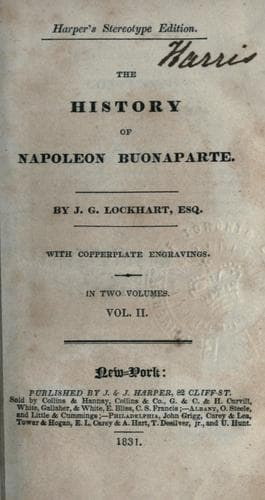
The History of Napoleon BuonaparteLockhart, J. G. (John Gibson)
History
The History of Napoleon Buonaparte
Lockhart, J. G. (John Gibson)
France -- Kings and rulers -- Biography; Napoleon I, Emperor of the French, 1769-1821
The battle of Roveredo (Sept. 4) is one of Napoleon's most illustrious
days. The enemy had a strongly entrenched camp in front of the town; and
behind it, in case of misfortune, Calliano, with its castle seated on a
precipice over the Adige, where that river flows between enormous rocks
and mountains, appeared to offer an impregnable retreat. Nothing could
withstand the ardour of the French. The Austrians, though they defended
the entrenched camp with their usual obstinacy, were forced to give way
by the impetuosity of Dubois and his hussars. Dubois fell, mortally
wounded, in the moment of his glory: he waved his sabre, cheering his
men onwards with his last breath. "I die," said he, "for the
Republic;--only let me hear, ere life leaves me, that the victory is
ours." The French horse, thus animated, pursued the Germans, who were
driven, unable to rally, through and beyond the town. Even the gigantic
defences of Calliano proved of no avail. Height after height was carried
at the point of the bayonet; 7000 prisoners and fifteen cannon remained
with the conquerors. The Austrians fled to Levisa, which guards one of
the chief defiles of the Tyrolese Alps, and were there beaten again.
Vaubois occupied this important position with the gallant division who
had forced it. Massena fixed himself in Wurmser's late headquarters at
Trent; and Napoleon, having thus totally cut off the field-marshal's
communication with Germany, proceeded to issue proclamations calling on
the inhabitants of the Tyrol to receive the French as friends, and seize
the opportunity of freeing themselves for ever from the dominion of
Austria. He put forth an edict declaring that the sovereignty of the
district was henceforth in the French Republic, and inviting the people
themselves to arrange, according to their pleasure, its interior
government.
The French general made a grievous mistake when he supposed that the
Tyrolese were divided in their attachment to the Imperial government,
because he had found the Italian subjects of that crown to be so. The
Tyrol, one of the most ancient of the Austrian possessions, had also
been one of the best governed; the people enjoyed all the liberty they
wished under a paternal administration. They received with scornful
coldness the flattering exhortations of one in whom they saw only a
cunning and rapacious enemy; and Buonaparte was soon satisfied that it
would cost more time than was then at his disposal to republicanise
those gallant mountaineers. They, in truth, began to arm themselves, and
waited but the signal to rise everywhere upon the invaders.
Public-domain text, read in full here on John Shaqi.
Reviews
Reviews
No reviews yet
Be the first to share your thoughts on this work.
Join the Discussion
Join the discussion
Sign in to leave a comment or review.
Sign InorCreate an account