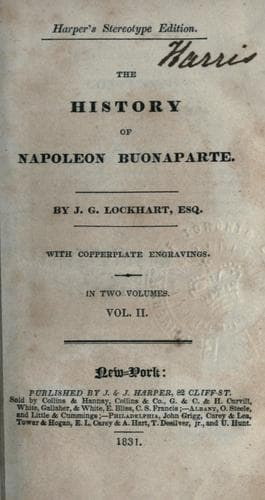
The History of Napoleon BuonaparteLockhart, J. G. (John Gibson)
History
The History of Napoleon Buonaparte
Lockhart, J. G. (John Gibson)
France -- Kings and rulers -- Biography; Napoleon I, Emperor of the French, 1769-1821
Next morning, having ascertained that Davidowich had not been engaged
with Vaubois, Napoleon once more advanced upon Arcola. The place was
once more defended bravely, and once more it was carried. But this
second battle of Arcola proved no more decisive than the first; for
Alvinzi still contrived to maintain his main force unbroken in the
difficult country behind; and Buonaparte again retreated to Ronco.
The third day was decisive. On this occasion also he carried Arcola;
and, by two stratagems, was enabled to make his victory effectual. An
ambuscade, planted among some willows, suddenly opened fire on a column
of Croats, threw them into confusion, and, rushing from the concealment,
crushed them down into the opposite bog, where most of them died.
Napoleon was anxious to follow up this success by charging the Austrian
main body on the firm ground behind the marshes. But it was no easy
matter to reach them there. He had, in various quarters, portable
bridges ready for crossing the ditches and canals; but the enemy stood
in good order, and three days' hard fighting had nearly exhausted his
own men. In one of his conversations at St. Helena, he thus told the
sequel. "At Arcola I gained the battle with twenty-five horsemen. I
perceived the critical moment of lassitude in either army--when the
oldest and bravest would have been glad to be in their tents. All my men
had been engaged. Three times I had been obliged to re-establish the
battle. There remained to me but some twenty-five _Guides_. I sent them
round on the flank of the enemy with three trumpets, bidding them blow
loud and charge furiously. _Here is the French cavalry_, was the cry;
and they took to flight."... The Austrians doubted not that Murat and
all the horse had forced a way through the bogs; and at that moment
Buonaparte commanding a general assault in front, the confusion became
hopeless. Alvinzi retreated finally, though in decent order, upon
Montebello.
It was at Arcola that Muiron, who ever since the storming of Little
Gibraltar had lived on terms of brotherlike intimacy with Napoleon,
seeing a bomb about to explode threw himself between it and his general,
and thus saved his life at the cost of his own. Napoleon, to the end of
his life, remembered and regretted this heroic friend.
Public-domain text, read in full here on John Shaqi.
Reviews
Reviews
No reviews yet
Be the first to share your thoughts on this work.
Join the Discussion
Join the discussion
Sign in to leave a comment or review.
Sign InorCreate an account