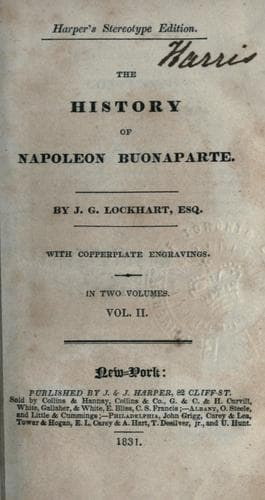
The History of Napoleon BuonaparteLockhart, J. G. (John Gibson)
History
The History of Napoleon Buonaparte
Lockhart, J. G. (John Gibson)
France -- Kings and rulers -- Biography; Napoleon I, Emperor of the French, 1769-1821
In the beginning of 1792 he became captain of artillery (_unattached;_)
and, happening to be in Paris, witnessed the lamentable scenes of the
20th of June, when the revolutionary mob stormed the Tuileries, and the
king and his family, after undergoing innumerable insults and
degradations, with the utmost difficulty preserved their lives. He
followed the crowd into the garden before the palace; and when Louis
XVI. appeared on a balcony with the red cap on his head, could no longer
suppress his contempt and indignation. "Poor driveller!" said Napoleon,
loud enough to be heard by those near him, "how could he suffer this
rabble to enter? If he had swept away five or six hundred with his
cannon, the rest would be running yet." He was also a witness of the
still more terrible 10th of August, when, the palace being once more
invested, the National Guard assigned for its defence took part with the
assailants; the royal family were obliged to take refuge in the National
Assembly, and the brave Swiss Guards were massacred almost to a man in
the courts of the Tuileries. Buonaparte was a firm friend to the
Assembly, to the charge of a party of which, at least, these excesses
must be laid; but the spectacle disgusted him. The yells, screams, and
pikes with bloody heads upon them, formed a scene which he afterwards
described as "hideous and revolting." At this time Napoleon was without
employment and very poor; and De Bourienne describes him as wandering
idly about Paris, living, chiefly at his (M. de B.'s) expense, at
restaurateurs' shops, and, among other wild-enough schemes, proposing
that he and his schoolfellow should take some houses on lease, and
endeavour to get a little money by subletting them in apartments. Such
were the views and occupations of Buonaparte--at the moment when the
national tragedy was darkening to its catastrophe. As yet he had been
but a spectator of the Revolution, destined to pave his own path to
sovereign power; it was not long before circumstances called on him to
play a part.
Public-domain text, read in full here on John Shaqi.
Reviews
Reviews
No reviews yet
Be the first to share your thoughts on this work.
Join the Discussion
Join the discussion
Sign in to leave a comment or review.
Sign InorCreate an account