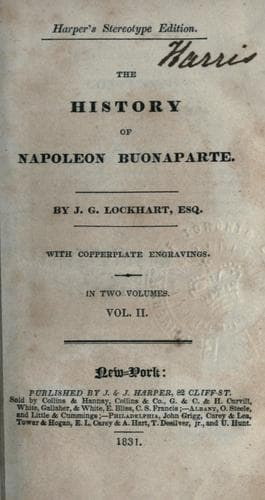
The History of Napoleon BuonaparteLockhart, J. G. (John Gibson)
History
The History of Napoleon Buonaparte
Lockhart, J. G. (John Gibson)
France -- Kings and rulers -- Biography; Napoleon I, Emperor of the French, 1769-1821
General Paoli, who had lived in England ever since the termination of
that civil war in which Charles Buonaparte served under his banner, was
cheered, when the great French Revolution first broke out, with the hope
that liberty was about to be restored to Corsica. He came to Paris, was
received with applause as a tried friend of freedom, and appointed
governor of his native island, which for some time he ruled wisely and
happily. But as the revolution advanced, Paoli, like most other wise
men, became satisfied that license was more likely to be established by
its leaders, than law and rational liberty; and avowing his aversion to
the growing principles of Jacobinism, and the scenes of tumult and
bloodshed to which they gave rise, he was denounced in the National
Assembly as the enemy of France. An expedition was sent to deprive him
of his government, under the command of La Combe, Michel, and Salicetti,
one of the Corsican deputies to the Convention; and Paoli called on his
countrymen to take arms in his and their own defence.
Buonaparte happened at that time (1793) to have leave of absence from
his regiment, and to be in Corsica on a visit to his mother. He had
fitted up a little reading-room at the top of the house as the quietest
part of it, and was spending his mornings in study, and his evenings
among his family and old acquaintance, when the arrival of the
expedition threw the island into convulsion. Paoli, who knew him well,
did all he could to enlist him in his cause; he used, among other
flatteries, to clap him on the back, and tell him he was "one of
Plutarch's men." But Napoleon had satisfied himself that Corsica was too
small a country to maintain independence,--that she must fall under the
rule either of France or England; and that her interests would be best
served by adhering to the former. He therefore resisted all Paoli's
offers, and tendered his sword to the service of Salicetti. He was
appointed provisionally to the command of a battalion of National
Guards; and the first military service on which he was employed was the
reduction of a small fortress, called the Torre di Capitello, near
Ajaccio. He took it, but was soon besieged in it, and he and his
garrison, after a gallant defence, and living for some time on
horseflesh, were glad to evacuate the tower, and escape to the sea. The
English government now began to reinforce Paoli, and the cause of the
French party seemed for the moment to be desperate. The Buonapartes were
banished from Corsica, and their mother and sisters took refuge first at
Nice, and afterwards at Marseilles, where for some time they suffered
all the inconveniences of exile and poverty. Napoleon rejoined his
regiment. He had chosen France for his country; and seems, in truth, to
have preserved little or no affection for his native soil.
Public-domain text, read in full here on John Shaqi.
Reviews
Reviews
No reviews yet
Be the first to share your thoughts on this work.
Join the Discussion
Join the discussion
Sign in to leave a comment or review.
Sign InorCreate an account