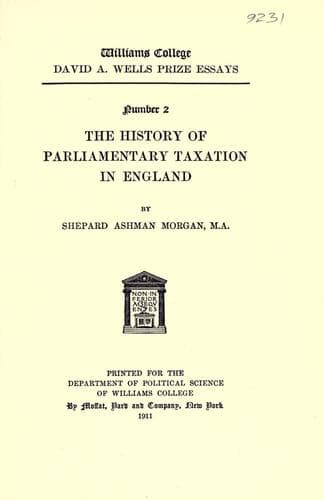
The History of Parliamentary Taxation in EnglandMorgan, Shepard Ashman
History
The History of Parliamentary Taxation in England
Morgan, Shepard Ashman
Taxation -- Great Britain; Taxation -- Great Britain -- History
He wasted no time in getting things started. In the proclamation
by which he summoned his first Parliament, he assumed the power of
dictating what manner of men should compose it, and directed that his
Court of Chancery should decide whether or not the certificates of
election fulfilled the royal conditions, “and if any shall be found to
be made contrarie to this proclamation, the same is to be rejected as
unlawful and insufficient.”[295] The commons, however, shortly after
their convening, vindicated their privilege in the case of Goodwin
and Fortescue, and succeeded in maintaining thereafter their right
to decide upon the legality of returns.[296] In their “Apology of
the House of Commons, made to the king, touching their Privileges,”
nearly at the close of this session, the commons complained against the
monopolies possessed by the great trading companies in the face of many
statutes to the contrary, and the oppressive exercise of the ancient
prerogative of purveyance.[297]
[James receives tunnage and poundage for life]
In the department of regular taxation, however, James at first adopted
a conciliatory attitude. On the 26th June, 1604, James sent to the
commons a letter “written with his own hand but corrected as to the
spelling,” in which he expressed his pleasure as to a subsidy.[298] He
stated his confidence in their good-will, assuring them “in the word
of a King” that he would “be so far from taking it unkindly, their not
offering” to him a subsidy, and that he would “only interpret it to
proceed from the care they have, that our people should not have any
occasion of distaste.” James’s letter accomplished for him what may
well have been his purpose; the commons immediately granted to him
tunnage and poundage for the space of his life.[299]
[Royal poverty]
At the two subsequent sessions of 1605-6 and 1606-7 there was constant
friction between king and commons, yet there were no very remarkable
assertions of royal prerogative or of parliamentary privilege. At the
session of 1605, Parliament granted the king three entire subsidies and
six fifteenths, designed principally to meet the royal indebtedness,
some of which held over since the time of Elizabeth.[300] After the
prorogation, James called no session of Parliament until the 9th
February, 1609-10.
But James could not meet his obligations with the ordinary revenues of
the crown. He was spending between £500,000 and £600,000 a year, and
his income was in the neighborhood of £400,000; his annual deficit,
therefore, was not far from £150,000.[301] James was obliged to turn
elsewhere, and the consequence of his action was the famous Bate
Case, the decision in which was a step toward freeing the king from
parliamentary control over his revenues.
[The Bate Case]
Public-domain text, read in full here on John Shaqi.
Reviews
Reviews
No reviews yet
Be the first to share your thoughts on this work.
Elsewhere in the archive
Join the Discussion
Join the discussion
Sign in to leave a comment or review.
Sign InorCreate an account