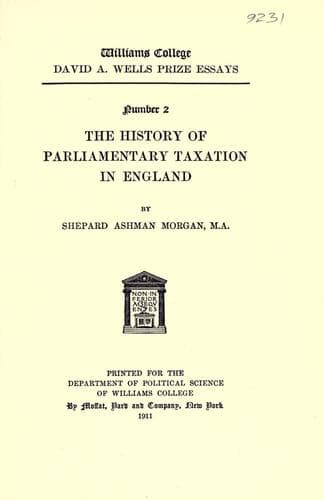
The History of Parliamentary Taxation in EnglandMorgan, Shepard Ashman
History
The History of Parliamentary Taxation in England
Morgan, Shepard Ashman
Taxation -- Great Britain; Taxation -- Great Britain -- History
Before the judgment was given, however, but not before it was clearly
discernible what was to be the trend of events, the commons set
themselves to the consideration of a supply bill and on the 18th March
passed it unanimously. It provided for two entire subsidies. “In the
midst of their inquiries into public grievances, the commons had
thought fit to consider the necessities of the State and grant the king
a supply.”[319]
[James in a temper adjourns Parliament]
The major part of the session was spent in reforming abuses, both
by impeaching the officials responsible for them, and by framing
legislation for their correction. Chief amongst those who fell under
condemnation at the bar of the House of Lords was Lord Francis
Bacon, Lord Chancellor of England, convicted of bribery. King James
in the early part of the session seemed not out of sympathy with
these efforts to reform the administration, but as time wore on and
the commons still busied themselves with investigations of official
misconduct, he wearied, and on the 28th May, the Lord Treasurer
declared to the lords the king’s determination to adjourn Parliament.
Two of the five reasons assigned for the adjournment were these:
“For that the profits of his Majesty’s revenues are, as it were, at
a stand;” and “The omission of the State.”[320] A week later, after
great complaint by the commons, the session was adjourned to reassemble
on the 14th November. Throughout the four months during which it had
sat, no complaint had been registered against the impositions at the
outports. Apparently the commons were willing for the moment to let
them rest, or else, as is more likely, were quite unmindful of them.
[Dilatory action on a subsidy]
Parliament met on the 20th November for its final session. Lord
Treasurer Cranfield reported that the exchequer was depleted, that the
two subsidies which had been granted the previous March had been spent
in furthering the interests of James’s son-in-law, Frederic, Elector
Palatine, and “that the business now in hand required a great and
speedy supply.”[321] It was understood that the cost of maintaining an
army in the Palatinate would be not far from £900,000 a year. The Lord
Treasurer wished “that the Commons would so handle this business as to
make his Majesty in love with the Parliaments.”
Public-domain text, read in full here on John Shaqi.
Reviews
Reviews
No reviews yet
Be the first to share your thoughts on this work.
Elsewhere in the archive
Join the Discussion
Join the discussion
Sign in to leave a comment or review.
Sign InorCreate an account