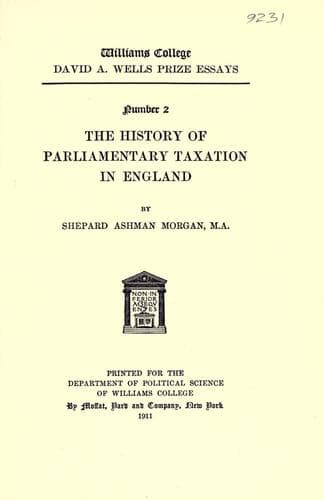
The History of Parliamentary Taxation in EnglandMorgan, Shepard Ashman
History
The History of Parliamentary Taxation in England
Morgan, Shepard Ashman
Taxation -- Great Britain; Taxation -- Great Britain -- History
But they took some time to consider it. At the end of the first week,
the commons resolved in committee of the whole house upon a single
subsidy, which, since it was to be levied doubly upon papists, would
provide some £100,000 for the prosecution of war in the Palatine.[322]
That was as near an actual grant as the commons came during the
session. On the 1st December, they fell into a conflict with the king
over matters of privilege, which had its rise in the imprisonment of
Sir Edwin Sandys during the last recess of Parliament, presumably for
utterances made in the House. There were petitions to James and replies
from him, culminating in a remarkable Protestation asserting the right
of free speech in the House.[323] On the day of the presentation of this
Protestation, the 18th December, James adjourned Parliament to the 8th
February; he then sent for the Journal of the House of Commons and tore
from it the objectionable entry with his own hand. In the stress of these
events, the proposed subsidy was allowed to slip out of mind; only did
the lords propose a meeting with the commons to consider a supply, and
this came to naught. On the 6th January, 1621-22, James saw fit not
to await the reassembling of Parliament, but issued a proclamation
of dissolution in which he denounced those who had questioned his
prerogatives in the House of Commons as “ill-tempered spirits.” Then he
committed to prison such of them as he regarded as being most hostile,
amongst whom were Sir Edward Coke, Pym, Selden, and Mallory.[324]
[James’s last Parliament, 1623-24]
[Supply granted for the Palatine war]
James convened his last Parliament on the 19th February, 1623-24. In
the interval which had elapsed since the dissolution, James recovered
his conciliatory attitude toward the commons. The plan of marrying the
Prince of Wales, the young Prince Charles, to the Infanta of Spain,
had been given up, and thus Englishmen were relieved of what to them
had been a pro-popish plot, and had been deprecated again and again as
the odious Spanish Match. The programme with respect to the Palatinate
favored by the king was that favored by the commons, and the reign
of James seemed to be approaching a happy conclusion. The commons
came forward with a grant of three subsidies and three fifteenths and
tenths, providing a somewhat greater sum than £300,000.[325] The money
was voted on the condition that, in order to insure its application to
the naval and military establishments, it be paid into the hands of
commissioners appointed by the commons, and be expended by them upon
direction of the council of war. The sympathy existing between king and
Parliament was further exhibited in the successful passage of an act
forbidding monopolies in the sale of any merchandise or in practicing
any trade, the only legislative act of constructive importance in his
reign.[326] Parliament was dissolved on the 29th May, 1624.
[Death of James I, 27th March, 1625]
Public-domain text, read in full here on John Shaqi.
Reviews
Reviews
No reviews yet
Be the first to share your thoughts on this work.
Elsewhere in the archive
Join the Discussion
Join the discussion
Sign in to leave a comment or review.
Sign InorCreate an account