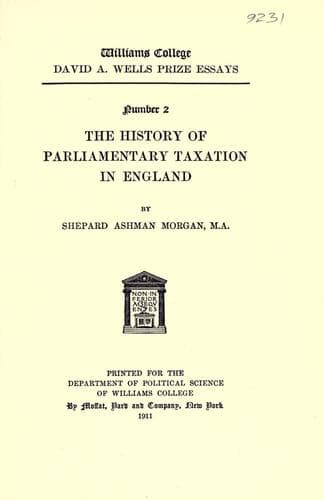
The History of Parliamentary Taxation in EnglandMorgan, Shepard Ashman
History
The History of Parliamentary Taxation in England
Morgan, Shepard Ashman
Taxation -- Great Britain; Taxation -- Great Britain -- History
Less than a year later King James died. Apparently at the end of
his reign he was learning wisdom for he was beginning to understand
Parliament. He left his crown to the keeping of a son who had in no
wise profited by the father’s experience. Charles I, brought up in an
atmosphere of divine right, was predisposed to pursue that theory to
the end. But worse than that, in arguing his melancholy destiny, was
his faithlessness. An odious policy executed without respect for truth
brought him at last to death outside his palace of Whitehall.
[First Parliament of Charles]
[Worry about the supply]
The first Parliament of Charles I recalls vividly the mid-reign
experiences of James. It convened on the 18th June, 1625, and was
met with a request for a large and unconditional grant with which
to prosecute the war which Charles had inherited from his father.
The commons, however, were careful; they looked rather for a solid
establishment of government at home than for a war abroad. Breaking
the habit of two centuries, they offered Charles tunnage and poundage
for a year instead of the term of his life, a measure which, because
of lack of precedent, was rejected in the House of Lords; and granted
only two subsidies.[327] On the 10th August, the chancellor delivered
a message to the commons from the king. He desired “a present answer
about his supply: If not, he will take care of their healths more than
they themselves, and make as good a shift for his present occasions
as he could.”[328] The House spent the rest of the day debating the
matter, and on the next proceeded in the consideration of grievances,
postponing the supply. Delay the king would not brook; perceiving that
the commons were bent upon a redress of grievances before the granting
of further aid, and because in the debates they had presumed “to
reflect upon some great persons near himself,” on the 12th August he
dissolved Parliament,[329] and looked to his privy seal as a means of
revenue.
[His second Parliament. Buckingham]
[A grant with hard conditions]
Public-domain text, read in full here on John Shaqi.
Reviews
Reviews
No reviews yet
Be the first to share your thoughts on this work.
Elsewhere in the archive
Join the Discussion
Join the discussion
Sign in to leave a comment or review.
Sign InorCreate an account