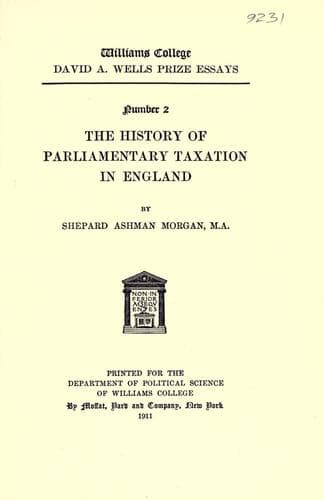
The History of Parliamentary Taxation in EnglandMorgan, Shepard Ashman
History
The History of Parliamentary Taxation in England
Morgan, Shepard Ashman
Taxation -- Great Britain; Taxation -- Great Britain -- History
Six months later, on the 6th February, 1625-26, Charles opened his
second Parliament and met with no better success. The commons did not
consider immediately the question of a supply, but to the immense
irritation of the king, proceeded to inquire into the conduct of the
Duke of Buckingham, the favorite of Charles. He sent a message to the
commons saying that he would “not allow any of his servants to be
questioned amongst them, much less such as are of eminent place and
near unto him.” But the chief significance of his message was in its
conclusion. “I wish you would hasten my supply,” so it ran, “or else it
will be worse for yourselves; for if any ill happen, I think I shall be
the last that shall feel it.”[330] The commons replied with a grant of
three subsidies and three fifteenths, but the conditions were such as
to make it almost worse for Charles than no grant at all. The bill was
not to be brought in until the king should have given answer to their
list of grievances, and among the grievances the Duke of Buckingham was
chief.[331] Later a fourth subsidy was added and a movement was put on
foot to give Charles tunnage and poundage for life; but in the bill it
was specified that a remonstrance should be drawn up against his taking
those duties without the previous consent of Parliament.[332] Then
the commons went on with their formal impeachment of Buckingham. But
before the matter was settled, and consequently before the Commons had
made final grants of the promised subsidies, Charles, in the hope of
relieving the desperate plight of his favorite, dissolved Parliament,
on the 15th June.
[Forced loans at the rating of a subsidy]
The dissolution left Charles without the means with which to carry on
the proposed war with Spain. He turned again to old expedients; he
forced loans, exacted benevolences, and suspended penal laws for a
consideration. The loans took the form of a general levy according to
the well-known rate of the subsidy and were thus in effect assessments
of a general tax by the arbitrary power of the crown. Of great
importance in the light of subsequent history, was the requisition made
upon the seaport towns for ships armed and equipped, the precursor of
the demand for ship money. Imprisonment, impressment into the royal
navy, the quartering of soldiers upon the inhabitants, the dismissal
from offices held of the crown, were the several rewards of those
sufficiently courageous to stand by the principle that taxes be laid
only by the assent of Parliament.[333] By an order in Council it was
declared, “that all customs, duties, and imposts on all goods and
merchandizes exported and imported, which, for many ages had been
continued, and esteemed a principal and necessary part of the revenue
of the crown, should be levied and paid.” The hope was expressed that
these levies “might receive an absolute settlement by Parliament,” when
that body should again assemble.[334]
[Charles’s third Parliament, 1627-28]
Public-domain text, read in full here on John Shaqi.
Reviews
Reviews
No reviews yet
Be the first to share your thoughts on this work.
Elsewhere in the archive
Join the Discussion
Join the discussion
Sign in to leave a comment or review.
Sign InorCreate an account