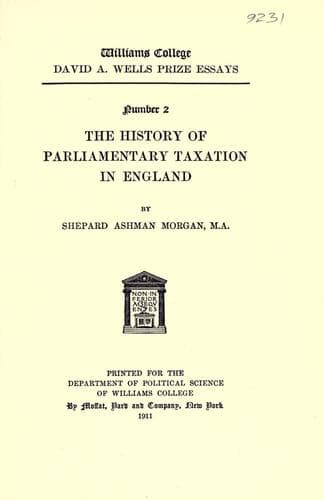
The History of Parliamentary Taxation in EnglandMorgan, Shepard Ashman
History
The History of Parliamentary Taxation in England
Morgan, Shepard Ashman
Taxation -- Great Britain; Taxation -- Great Britain -- History
[Threats of non-Parliamentary exaction]
Not being content with the financial difficulties incident to the war
with Spain, Charles, at the suggestion of Buckingham, slipped into
a war with France. Buckingham led an expedition to the Isle of Rhé,
met with disaster and ignominy, and succeeded in using up the ready
money of the king. Charles had to call his third Parliament in order
to obtain supplies. It met 17th March, 1627-28. The king attempted to
propitiate the commons by releasing the prisoners whom he still held
for refusing to meet the demand for the general loan. In his opening
speech, Charles took the wrong tack. “There is none here,” he said,
“but knows that common danger is the cause of this Parliament, and
that supply at this time is the chief end of it.... If you, (which God
forbid) should not do your duties in contributing what the State at
this time needs, I must in discharge of my conscience, use those other
means which God hath put into my hands, to save that which the follies
of some particular men may otherwise hazard to lose.”[335] Nor was this
bold assertion of the divine right of a king to put his hand in the
pockets of his subjects enough. The lord keeper said in addition, “This
way (of obtaining a supply), as his Majesty hath told you, he hath
chosen, not as the only way, but as the fittest; not as destitute of
others, but as most agreeable to the goodness of his own most gracious
disposition, and to the desire and weal of his people. If this be
deferred, necessity and the sword of the enemy will make way to others.
Remember his Majesty’s admonition: I say, remember it.”[336]
[Grievances have precedence]
[Denunciation of extortions]
The House immediately set itself to the consideration of grievances,
chief amongst which were “raising money by loans, by benevolences, and
privy seals: and what was too fresh in memory, the imprisonment of
certain gentlemen who refused to lend.”[337] The matter of a supply
was debated, but passed by in favor of the grievances. On the 3rd
April, the commons agreed unanimously to certain highly significant
resolutions against the powers assumed by the king. “No freeman ought
to be committed, or detained in prison, or otherwise restrained,” they
said, “by command of the king, or the Privy Council, or any other,”
except for lawful cause expressed in a lawful warrant; and “that
the ancient and undoubted right of every freeman is, that he hath a
full and absolute property in his goods and estate; and that no tax,
tallage, loan, benevolence, or other like charge, ought to be commanded
or levied by the king or his ministers, without common assent of
Parliament.”[338]
Public-domain text, read in full here on John Shaqi.
Reviews
Reviews
No reviews yet
Be the first to share your thoughts on this work.
Elsewhere in the archive
Join the Discussion
Join the discussion
Sign in to leave a comment or review.
Sign InorCreate an account