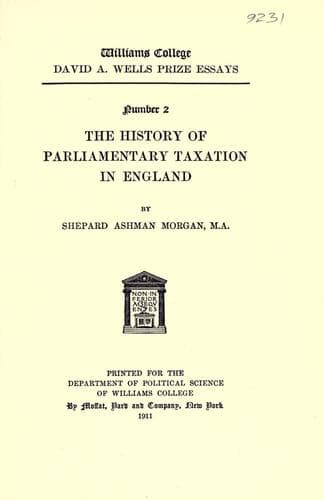
The History of Parliamentary Taxation in EnglandMorgan, Shepard Ashman
History
The History of Parliamentary Taxation in England
Morgan, Shepard Ashman
Taxation -- Great Britain; Taxation -- Great Britain -- History
For the space of two months the commons and the House of Lords engaged
themselves in conference and separately in the consideration of a
petition defining, the rights asserted in the resolutions. On the part
of the commons the chief advocates were Selden, Littleton, and Digges;
Sir Edward Coke, whose unwillingness to bend the judicial knee to King
James had procured his dismissal long since from the chief-justiceship;
and Noy, the genius who was shortly to turn against the Commons and
in his invention of ship money furnish a means whereby to lay taxes
without parliamentary assent. The interest of the crown was defended by
attorney-general Heath and Sergent Ashley. The king was in a dilemma;
he could not permit the petition to be brought in, in parliamentary
form, and he could not dissolve Parliament without losing five
subsidies which the commons had signified their willingness to grant
him.[339] He therefore tried to steer a middle course; he offered to
Parliament his royal word not to imprison unjustly and expressed his
willingness to confirm the charters. Coke, however, insisted upon a
specific statement of issues; any such hazy settlement of difficulties
as the king proposed was unlikely to be permanent; definiteness was
essential. To that end he proposed the drawing up of a Petition of
Right.
[The Petition of Right]
When the instrument was at last drawn up, it was sent to the House
of Lords. The lords attempted to introduce an amendment designed “to
leave entire that sovereign power,” as the proposed change itself ran,
“wherewith your Majesty is trusted for the protection, safety and
happiness of your people;”[340] but the commons would have none of it,
and at last the lords yielded their assent. The king at first gave a
cumbersome, evasive answer to the petition which was in reality no
answer at all,[341] and roused thereby a storm of indignation, which
exhibited itself in a movement to censure Buckingham. This the king
averted by signing the Petition of Right in the usual manner, and
received in consequence his five subsidies.[342]
[The statutes cited in the Petition]
Public-domain text, read in full here on John Shaqi.
Reviews
Reviews
No reviews yet
Be the first to share your thoughts on this work.
Elsewhere in the archive
Join the Discussion
Join the discussion
Sign in to leave a comment or review.
Sign InorCreate an account