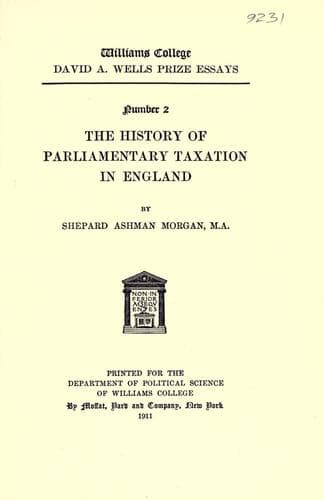
The History of Parliamentary Taxation in EnglandMorgan, Shepard Ashman
History
The History of Parliamentary Taxation in England
Morgan, Shepard Ashman
Taxation -- Great Britain; Taxation -- Great Britain -- History
The effect of this decision upon the minds of the people was immediate;
it changed the payment of the ship money from a semi-voluntary gift
to the king into an extortion enforced by him. Previously they had
supposed that the ship money was paid out of sufferance, that if it
became too heavy, an appeal to the courts would be sufficient to remove
it; now they felt that the king had them by the throat and could force
them to do as he willed. Never was there a clearer issue; the king and
his prerogative against the commons and their long-developing rights;
the power of the king to levy taxes upon his own arbitrary authority
against taxation by the will of the taxed as expressed in Parliament.
[The Short Parliament, 1640]
The Scottish rebellion of 1638 which was waged for the defense of
religious freedom, and the interval of peace, beginning the 18th
June, 1639, which was used by Scots and English alike as a period of
armament, proved too much for Charles’s irregular financial supply.
Reluctantly he called his Fourth Parliament, commonly known as the
Short Parliament, for the 13th April, 1640. The assembly was, strange
to say, most moderate and loyal to the king. Charles through the
ex-Speaker Sir John Finch, now Lord Keeper, asked for a large supply
immediately, saying that he would listen to grievances afterwards.[364]
[Clash between the Houses]
The commons recalled instances wherein the royal word had been broken,
and preferred to withhold supply until the end of the session,
according to their familiar habit. They proceeded to inquire into the
Hampden case, and considered in detail the various occasions upon
which the law had been broken during their eleven years’ recess.
They appointed a committee to confer with the lords over a long list
of grievances, divided into the three departments of innovations in
religion, invasions of private property, and breaches of parliamentary
privilege.[365] At this Charles came forward with a gigantic piece of
tactlessness; thinking he saw a hole through which he could escape,
he tried to win the lords to his standard. Applying to them, they
voted and communicated to the House of Commons that “his Majesty’s
supply should have the precedency, and be resolved on before any other
matter whatsoever.”[366] To the commons this appeared an arrant breach
of privilege, it being their right that money bills should originate
in their House. The lords immediately adopted a conciliatory tone;
they renounced any intention of offending the commons. “The bill of
subsidies,” they admitted, “ought to have its inception and beginning
in your House; and that when it comes up to their lordships, and is by
them agreed unto, it must be returned back to you and be by your House
presented.”[367]
Public-domain text, read in full here on John Shaqi.
Reviews
Reviews
No reviews yet
Be the first to share your thoughts on this work.
Elsewhere in the archive
Join the Discussion
Join the discussion
Sign in to leave a comment or review.
Sign InorCreate an account