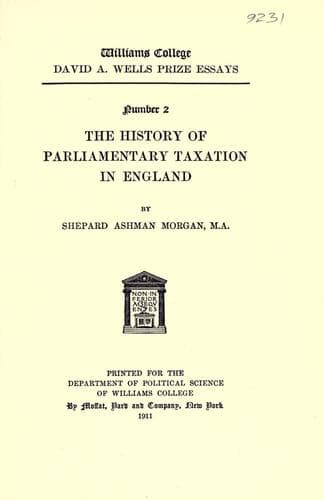
The History of Parliamentary Taxation in EnglandMorgan, Shepard Ashman
History
The History of Parliamentary Taxation in England
Morgan, Shepard Ashman
Taxation -- Great Britain; Taxation -- Great Britain -- History
The first of these instances is the eleventh section of the Charter
of Liberties which Henry I issued at the moment of his accession. The
significant passage is this: “To those knights who hold their lands by
the cuirass, of my own gift I grant the lands of their demesne ploughs
free from all payments and all labor.”[22] The king goes on to state
the reason; it was “so they may readily provide themselves with horses
and arms for my service and for the defense of my kingdom.” The relief
thus granted was by way of protection against the extortionate demands
which Ranulf Flambard had laid upon the lands of vassals in the time
of William Rufus. But Henry did not grant the liberty freely out of
hand. He appended the clause that for his service and the defense of
the kingdom, the vassals should supply themselves with horses and arms.
Thus remotely and in effect rather than in fact did the Charter touch
upon taxation. It contained no reference to assent by the vassals,
either individually or in the National Council. In accordance with the
feudal theory of individual contribution for the support of the lord,
and in view of the provision in the Charter against payments, the
inference can be drawn that individual assent would be in order. But to
find an answer to the question as to where the collective assent of the
barons was obtained, if at all, one must look further.
[Question of assent to taxation]
[In the Shire Moots]
In a letter addressed to “Samson the Bishop and Urso d’Abitat,” who
were respectively the bishop of the diocese and the sheriff of the
county of Worcester, Henry says, in speaking of the county courts, “I
will cause those courts to be summoned when I will for my own proper
necessities at my pleasure.”[23] That these county courts were utilized
by the Norman kings for purposes of extortion, is attested by the
reluctance of the suitors to attend their sessions,[24] and in the
light of that fact, the “proper necessities” of the king are apparently
none other than the royal need for money. But why, if the assent of
the taxed was not required, should the courts be summoned to meet the
“proper necessities” of the crown? Would that purpose be subserved
merely by making a demand for money? Had that been the fact, the
courts might well have been left to carry on their peculiar functions
untroubled, for extortion can be the more readily practiced king to man
than king to people. The conclusion is reasonable, notwithstanding the
very large part which conjecture plays in it, that some form of assent
was usual in the county courts in response to the royal demands.
[In the National Council]
Public-domain text, read in full here on John Shaqi.
Reviews
Reviews
No reviews yet
Be the first to share your thoughts on this work.
Join the Discussion
Join the discussion
Sign in to leave a comment or review.
Sign InorCreate an account