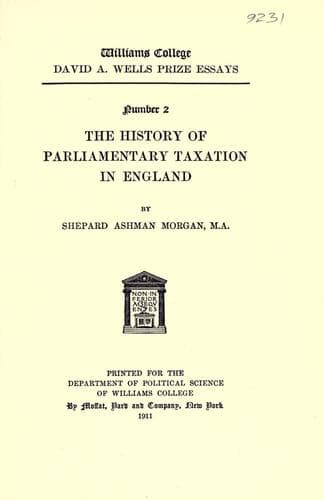
The History of Parliamentary Taxation in EnglandMorgan, Shepard Ashman
History
The History of Parliamentary Taxation in England
Morgan, Shepard Ashman
Taxation -- Great Britain; Taxation -- Great Britain -- History
The unlucky thirteen years of the reign of William Rufus, who succeeded
to the throne upon the death of the Conqueror in 1087, are almost
negligible in considering the progress toward parliamentary taxation.
William Rufus, or more particularly his brilliant and perverted
justiciar, Ranulf Flambard, determined upon the profitable program of
getting together as much money as possible by whatever means seemed
most convenient. In the nature of things the church and the great
feudatories were the most available sources for extortion and toward
them Flambard chiefly directed his energies. He did not, however,
overlook the Danegeld and he seems to have levied it with perfect
absolutism. The chronicler Florence gives an instance of the petty
extortion which the justiciar practiced upon the people. Flambard was
in the habit of enforcing military service from the shires. On one
occasion, so says Florence, he met the array, informed the militiamen
that there was no necessity for their appearance, and then proceeded to
mulct them of the ten shillings which their shires had given to each by
way of providing for their maintenance.[21] Against plunderings of that
sort the people were too weak and too disunited to make resistance. In
such a reign, with one side unwilling to progress and the other unable,
it is apparent that no steps could be taken toward the granting of
taxes by a responsible body.
[Henry I, 1100-1135]
The reign of Henry I is of greater importance, not only because of
the long forward strides which the king and his justiciar Roger of
Salisbury took in the direction of judicial and financial organization,
but because we find in the records of his time certain pieces of
evidence which seem to support the contention that the Council gave
some measure of consent to taxation. The former is palpably beyond the
scope of this essay, but the latter is more pertinent.
[His Charter]
Public-domain text, read in full here on John Shaqi.
Reviews
Reviews
No reviews yet
Be the first to share your thoughts on this work.
Join the Discussion
Join the discussion
Sign in to leave a comment or review.
Sign InorCreate an account