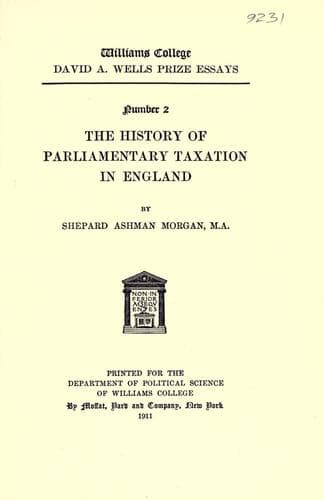
The History of Parliamentary Taxation in EnglandMorgan, Shepard Ashman
History
The History of Parliamentary Taxation in England
Morgan, Shepard Ashman
Taxation -- Great Britain; Taxation -- Great Britain -- History
Wool, a custom on, 1275, 111-113;
seizure of, 1294, 124;
seizure of, 1297, 136;
tax on, under _Confirmatio Cartarum_, 147-148;
increased duties to foreign merchants, 1302, 158;
rate reëstablished, 165;
assaults of Edward III upon the wool customs, 172-177;
statute for Parliamentary control, 177;
practice at variance with it, 180-183;
proceeds of a subsidy in time of Richard II, 197.
See also New Customs, Ancient Customs.
York, Geoffrey of, refuses assent to John’s thirteenth, 56.
FOOTNOTES:
[1] Tacitus, _Germania_, cap. xv. “Mos est civitatibus ultro ac viritim
conferre principibus vel armentorum vel frugum, quod pro honore
acceptum etiam necessitatibus subvenit.”
[2] Vinogradoff, _Growth of the Manor_, 142, 143.
[3] The _heriot_, unlike the feudal incident known to the Normans as a
_relief_, was a repayment to the king upon the death of a vassal, of
the various accoutrements with which he had been endowed. The statute
of Cnut II, § 72, fixes the heriot of an earl at eight horses, four
suits of armor, and two hundred mancuses of gold. The heriot varied in
amount according to the rank of the deceased vassal. The statute is
given in Stubbs, _Select Charters_, 74.
[4] Florentii Wigorniensis, _Chronicon ex Chronicis_, a. 991, p. 149.
[5] “This tax was levied by reference to the hides into which in the
various hundreds of the shire, land was divided for the purposes of
taxation.” The hide was the equivalent of 100 or 120 acres. The rate
was one to four shillings, as occasion required. 1 Dowell, _History of
Taxation and Taxes in England_, 8.
[6] Amount in 1002, £24,000.--Flor. Wig. a. 1002, p. 155. Amount in
1007, £36,000.--Flor. Wig. a. 1007, p. 159. Amount in 1011 not stated.
[7] 1 Dowell, _History of Taxation and Taxes in England_, 10.
[8] 1 Roger of Hoveden, 110.
[9] Decretum est primum iam ut solveretur tributum Danicis viris,
propter magnos horrores quos incusserunt incolis maritimis; in
primis nempe, X milia librarum. Illud consilium constituit Siricus
Archiepiscopus. _Chron. Sax._ a. 991.
[10] Tunc rex Aegelredus, procerum suorum consilio, ad eos legatos
misit, promittens tributum et stipendium ea conventione illis se
daturum, ut a sua crudelitate omnino desisterunt. Flor. Wig. 151, 152;
a. 994.
[11] Flor. Wig. 155, 159, 163; a. 1002, 1007, 1011.
[12] Medley, _English Constitutional History_, 117, 118.
[13] 2 Kemble, _Saxons in England_, 204-240.
[14] At the great Gemôt of Salisbury, 1086, William put an end to the
disrupting effects of subinfeudation by causing all holders of land,
whether their tenure was mediate or immediate of him to swear primary
allegiance to the king.
[15] 1 Stubbs, _Const. Hist. Eng._ 385, note.
[16] 2 Flor. Wig. 17, a. 1084; and 1 Rogeri de Hoveden, 139. “Rex
Anglorum Willelmus de unaquaque hida per Angliam sex solidos accepit.”
This rate of six shillings the hide was three times as great as the
amount under the Saxons.
Public-domain text, read in full here on John Shaqi.
Reviews
Reviews
No reviews yet
Be the first to share your thoughts on this work.
Elsewhere in the archive
Join the Discussion
Join the discussion
Sign in to leave a comment or review.
Sign InorCreate an account