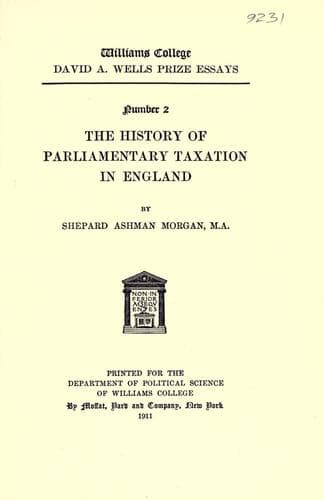
The History of Parliamentary Taxation in EnglandMorgan, Shepard Ashman
History
The History of Parliamentary Taxation in England
Morgan, Shepard Ashman
Taxation -- Great Britain; Taxation -- Great Britain -- History
[183] “5. And for so much as divers people of our realm are in fear
that the aids and tasks which they have given to us beforetime towards
our wars and other business, of their own grant and good will,
howsoever they were made, might turn to be a bondage to them and their
heirs, because they might be at another time found in the rolls, and so
likewise the prises taken throughout the realm by our ministers in our
name; we have granted for us and our heirs, that we shall not draw such
aids, tasks, nor prises into a custom, for anything that hath been done
heretofore, or that may be found by roll or in any other manner.” Adams
and Stephens, _Sel. Doc._ 87. Stubbs, _Sel. Chart._ 495 (French text)
and 496 (translation). Original in 2 Walt. de Hemingb. 149.
[184] “6. Moreover we have granted for us and our heirs as well to
archbishops, bishops, abbots, priors, and other folk of holy Church, as
also to earls, barons, and to all the commonalty of the land, that for
no business from henceforth we shall take of our realm such manner of
aids, tasks, nor prises, but by the common assent of all the realm, and
for the common profit thereof, saving the ancient aids and prises due
and accustomed.
“And for so much as the mere part of the commonalty of the realm
find themselves sore grieved with the maletolt of wools, that is to
wit, a toll of forty shillings for every sack of wool, and have made
petition to us to release the same; we at their requests have clearly
released it, and have granted that we will not take such thing nor any
other without their common assent and good will; saving to us and our
heirs the custom of wools, skins, and leather, granted before by the
commonalty aforesaid. In witness of which things we have caused these
our letters to be made patents.” Adams and Stephens, _Sel. Doc._ 87;
Stubbs, _Sel. Chart._ 495 (French text), and 496 (translation).
[185] 2 Walt. de Hemingb. 152, 153.
[186] The statute is in Adams and Stephens, _Sel. Doc._ 88, translated.
The Latin text is in Stubbs, _Sel. Chart._ 497, 498.
[187] In this connection see McKechnie, _Magna Carta_, 281; 2 Stubbs,
_Const. Hist. Eng._ 148-150, and _Sel. Chart._ 497; Medley, _Eng.
Const. Hist._ 507, 508.
[188] _Patent Rolls_, 24th Oct., 1301, in Stubbs, _Sel. Chart._ 446.
[189] See 2 Stubbs, _Const. Hist. Eng._ 156-158, citing 1
_Parliamentary Writs_, 104.
[190] 2 Walt. de Hemingb. 223.
[191] 1 _Parl. Writs_, 134-135, in Stubbs, _Sel. Chart._ 500-501.
[192] Carta Mercatoria, in Hall, 1 _History of the Customs_, Appendix,
202-208; 1 ibid. 69-70.
[193] 2 Walt. de Hemingb. 233; _Patent Rolls_, a. 1304, 6th Feb., in
Stubbs, _Sel. Chart._ 447.
[194] 1 _Rot. Parl._ 161-162.
[195] The only other instance of taxation to be noted was the aid
granted in 1306 by knights and barons (a thirtieth), and by citizens
and burgesses (a twentieth), on the occasion of knighting the king’s
son. 1 Rymer, _Foedera_, part 4, 48.
Public-domain text, read in full here on John Shaqi.
Reviews
Reviews
No reviews yet
Be the first to share your thoughts on this work.
Elsewhere in the archive
Join the Discussion
Join the discussion
Sign in to leave a comment or review.
Sign InorCreate an account