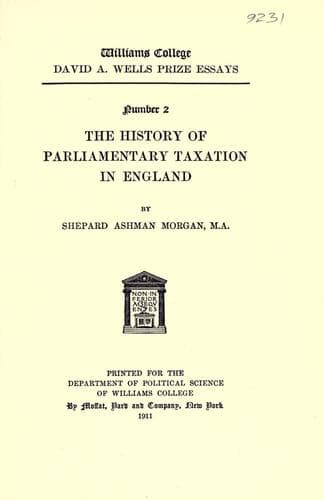
The History of Parliamentary Taxation in EnglandMorgan, Shepard Ashman
History
The History of Parliamentary Taxation in England
Morgan, Shepard Ashman
Taxation -- Great Britain; Taxation -- Great Britain -- History
[196] 1 Rymer, _Foedera_, part 4, 112. Also, Stubbs, 2 _Const. Hist.
Eng._ 331.
[197] A Parliament of the three Estates at Northampton, 13th Oct.,
1307, granted him an aid on the event of his marriage and coronation,
and for the burial of Edward I. The clergy granted a fifteenth, the
towns a fifteenth, and the barons and knights a twentieth of movables.
1 _Rot. Parl._ 442.
[198] 1 _Rot. Parl._ 443-445.
[199] The second article is given in translation in Hall, 1 _History of
the Customs_, Appendix, 208.
[200] 1 _Rot. Parl._ 446-447.
[201] Translation given in Adams and Stephens, _Sel. Doc._ 93.
[202] 2 Stubbs, _Const. Hist. Eng._ 340, note 1, and citations.
[203] 1 _Rot. Parl._ 281-286.
[204] Translation given in Adams and Stephens, _Sel. Doc._ 93-94.
[205] 2 Stubbs, _Const. Hist. Eng._ 345 and note 2, with citations.
[206] Edward, despite the ordinance banishing Gaveston, in January,
1312, recalled him. But the restoration was fatal to the favorite.
Thomas of Lancaster intercepted him on his way back to London and
murdered him. Gaveston was avenged, however, in 1322, when Edward for
the moment securing the upper hand, took Lancaster and beheaded him.
[207] 1 _Rot. Parl._ 449.
[208] Other instances of taxation during the reign were: 1313,
October. Parliament grants a tax on movables,--the barons and knights
a twentieth and the towns a fifteenth. Grant made in consequence of
a general pardon issued by Edward. 1 _Rot. Parl._ 448. Cf. Thom.
Walsingham, _Hist. Anglicana_, ed. 1 Riley, 136. 1315, Jan.-March.
King put on an allowance of £10 a day. The clergy grant a tenth on
certain conditions, the towns a fifteenth and the barons and knights
a twentieth. 2 Stubbs, _Const. Hist. Eng._ 355, and citations. 1316.
Towns grant a fifteenth, the knights and barons offer a soldier to be
supported by each township, and the clergy express their willingness to
contribute a tenth in their own convocations. 1 _Rot. Parl._ 450-451. 2
Stubbs, _Const. Hist. Eng._ 356. The grant of a soldier was afterward
compounded for by a grant of a sixteenth. 1319. The towns grant a
twelfth, the barons and knights an eighteenth. 1 _Rot. Parl._ 454-455.
1320. No taxes, save a clerical tenth, granted by the Pope. 2 Stubbs,
_Const. Hist. Eng._ 363, note 2. 1322. Clergy grant a tenth for 2
years. Knights and barons grant a man-at-arms from each township for 40
days. Commuted by money payment. Edward, being for the moment supreme,
restores the New Customs for a year. 2 Stubbs, _Const. Hist. Eng._ 370,
and note 2 and authorities there cited.
[209] Sept. 1327. Parliament at Lincoln granted a twentieth for the
Scotch war. 2 _Rot. Parl._ 425.
[210] 2 Ibid. 446.
[211] 2 Ibid. 66.
[212] 2 Stubbs, _Const. Hist. Eng._ 554.
[213] 2 Rymer, _Foedera_, Aug. 12, 1336.
[214] 1 Hen. Knighton, _Chronicon_, ed. Lumby, 477.
[215] Adam Murimuth, _Chronica_ ed. Hog, 81.
Public-domain text, read in full here on John Shaqi.
Reviews
Reviews
No reviews yet
Be the first to share your thoughts on this work.
Elsewhere in the archive
Join the Discussion
Join the discussion
Sign in to leave a comment or review.
Sign InorCreate an account