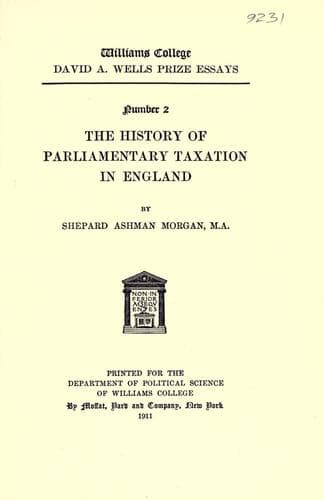
The History of Parliamentary Taxation in EnglandMorgan, Shepard Ashman
History
The History of Parliamentary Taxation in England
Morgan, Shepard Ashman
Taxation -- Great Britain; Taxation -- Great Britain -- History
A number of other incidents of the reign of Henry II, though they
lack the color of a controversy between archbishop and monarch, are
nevertheless worthy of consideration. The imposition in 1159 of the
Great Scutage, despite the fact that it came as a feudal charge rather
than as a form of regular taxation, assumes great importance in view of
the part that scutage played in the evolution of the taxing power.
Scutage is generally considered as one of the forms of “commutation
for personal service,” and commutation was undoubtedly the underlying
idea of the imposition.[34] The payment was made for every knight owing
military service. Each knight holding of the king was expected to
serve in the field for forty days. Eight pence a day in the reign of
Henry II was the usual wages of a knight, and for forty days the wages
would amount to two marks, which was the sum most commonly paid in lieu
of personal service. It was in its earlier phase distinctly a feudal
charge.
[Early instances of Scutage]
Payment of scutage, like most of the other forms of feudal and general
taxation, struck its roots far into the past. Bishop Stubbs fixes 1156
as the year in which the term scutage was first employed.[35] Others
find counterparts in various payments to the sovereign in the time
before and shortly after the Conquest. In the reign of Henry I the
practice of allowing ecclesiastics to compound at a fixed rate for
the knight-service due from their estates was generally followed. The
privilege was sometimes extended to mesne tenants.[36] One writer[37]
points to Ranulf Flambard’s device in 1093, when he took from the
men of the fyrd the money which had been given them for the purchase
of supplies while on the march. Others[38] suggest the Anglo-Saxon
_fyrdwite_, the payment made by the king’s men when they were absent
from the royal train in war time as the analogy and precedent for
scutage. It seems more likely that the king and his vassals adopted a
money payment in lieu of service because it was convenient for both
of them.[39] The king thereby got the means for the enlistment of a
body of mercenaries, subject to his absolute will, and the barons were
relieved, if so they pleased, of the burden of military service.
[The Great Scutage, 1159]
Public-domain text, read in full here on John Shaqi.
Reviews
Reviews
No reviews yet
Be the first to share your thoughts on this work.
Join the Discussion
Join the discussion
Sign in to leave a comment or review.
Sign InorCreate an account