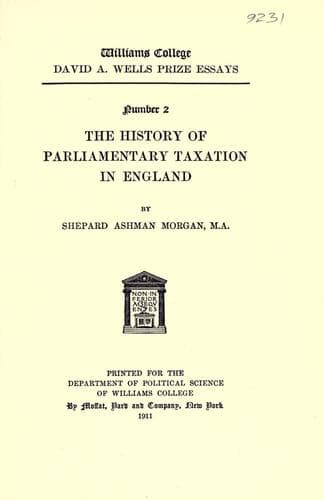
The History of Parliamentary Taxation in EnglandMorgan, Shepard Ashman
History
The History of Parliamentary Taxation in England
Morgan, Shepard Ashman
Taxation -- Great Britain; Taxation -- Great Britain -- History
This was from the chancellor turned archbishop. In his former estate
Becket had not shrunk from pressing money composition for military
service from prelates holding land of the crown on the ground that they
were tenants-in-chief and therefore owed service of arms to the king.
But now he had changed his masters and stood champion of the church.
To him Henry returned, “By the eyes of God, it shall be given as
revenue, and it shall be entered in the king’s accounts; and you have
no right to contradict; no man wishes to oppress your men against your
will.”
“My lord king,” Becket declared, “by the reverence of the eyes by which
you have sworn, it shall not be given from my land and from the rights
of the church not a penny.”
Apparently for the moment the archbishop won his point, but from
that time on, Becket and the king stood apart. The continuation of
the struggle between them at Westminster the following October; the
Constitutions of Clarendon, sweeping away much of the exclusive
authority which previously had characterized ecclesiastical
jurisdiction; the flight of Becket into France; the coronation of the
young Henry by the Archbishop of York to the prejudice of Becket, and
the latter’s declaration of illegality; these and the martyrdom of the
archbishop, are parts of another story.
[The issue in the Woodstock Controversy, 1163]
Exactly what were the motives of Becket in making his stand against
the king at the Council of Woodstock, are somewhat difficult of
determination. The interest of the king was obvious; he wished to
increase his revenue by annexing the “auxilium vicecomitis” or
“Sheriff’s aid,” which had not gone into the royal treasury at all but
had served to swell the private income of the sheriffs. Whether Becket,
“standing on the sure ground of existing custom,”[33] objects to change
merely because it was a change; or whether he had in mind some lofty
democratic principle, and took his stand against the royal power in
favor of the lesser folk through some flush of democratic fervor, is
not only impossible of being decided, but the decision would not be of
strict relevance to the subject. The two points to observe, and they
are perfectly evident, are that Becket’s stand against the king did not
concern a new levy of taxes, but an imposition already customary; and
that the king asserted Becket’s incompetency to interfere. Becket had
presumed to take a hand in a matter connected with taxation; the king
had denied him that right, though the archbishop was the chief member
of his National Council. Therein lay a great issue.
[Scutage]
Public-domain text, read in full here on John Shaqi.
Reviews
Reviews
No reviews yet
Be the first to share your thoughts on this work.
Join the Discussion
Join the discussion
Sign in to leave a comment or review.
Sign InorCreate an account