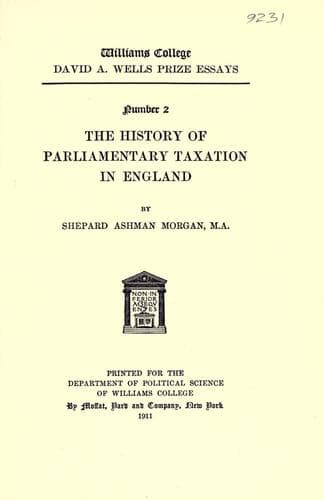
The History of Parliamentary Taxation in EnglandMorgan, Shepard Ashman
History
The History of Parliamentary Taxation in England
Morgan, Shepard Ashman
Taxation -- Great Britain; Taxation -- Great Britain -- History
In publishing this volume occasion is taken to state the purpose of
the competition. Since it is confined to students and graduates of a
college which offers no post-graduate instruction, it is not intended
to require original historical research but rather to encourage a
thoughtful handling of problems in political science.
THEODORE CLARKE SMITH,
J. Leland Miller Professor of
American History
WILLIAMS COLLEGE,
WILLIAMSTOWN, MASS., December, 1910.
INTRODUCTION
IN a chapter of Hall’s Chronicle having to do with the mid-reign
history of Henry VIII occurs an instance of popular protest against
arbitrary taxation. The people are complaining against the Commissions,
says the Chronicler, bodies appointed by the Crown to levy taxes
without consent of Parliament. “For thei saied,” so goes the passage,
“if men should geue their goodes by a Commission, then wer it worse
than the taxes of Fraunce, and so England should be bond and not free.”
Hall’s naïve statement is scarcely less than a declaration of the
axiomatic principle of politics that self-taxation is an essential of
self-government.
Writers on the evolution of the taxing power are inclined to go a step
farther and believe that the liberty of a nation can be gauged most
readily by the power of the people over the public purse. With a view
so extended a narrative of the growth of popular control in England
might easily expand into a history of the English Constitution. In the
present essay, however, an effort has been made to exclude all matters
which were not of the strictest pertinency to the subject in hand.
Feudal dues and incidents, the machinery of taxation, the Exchequer,
the forces accounting for the shifting composition of the national
assemblies, these and other matters have been treated of in outline
rather than in detail, because they appeared to lie beyond the scope of
this essay.
Only two matters have been taken to be of first rate importance,--the
tax and the authority by which it was laid. Taxation has been construed
broadly as being any contribution levied by the government for its
own support. An endeavor has been made in each instance to find out
who or what the taxing authority was, and whether the tax was laid
in accordance with it. Under the Normans the taxing authority was
unmistakably the king, and by the Bill of Rights it lay as unmistakably
in Parliament, with the right of initiation in the House of Commons.
The story of the shift from one position to the other forms, of
course, the major burden of the essay.
Public-domain text, read in full here on John Shaqi.
Reviews
Reviews
No reviews yet
Be the first to share your thoughts on this work.
Join the Discussion
Join the discussion
Sign in to leave a comment or review.
Sign InorCreate an account