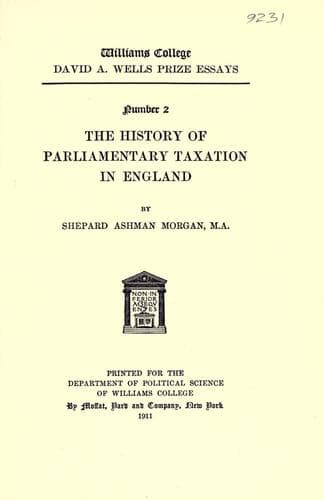
The History of Parliamentary Taxation in EnglandMorgan, Shepard Ashman
History
The History of Parliamentary Taxation in England
Morgan, Shepard Ashman
Taxation -- Great Britain; Taxation -- Great Britain -- History
At the time when the subject was assigned, the power of the House of
Commons over money bills had not been brought into question for more
than two centuries, and the first drafts had been written and the prize
awarded before the Asquith ministry was confronted with the problem of
interference by the House of Lords. At this writing the question has
not been settled. It has seemed advisable therefore to leave the essay
within the bounds originally set for it, and what connection it has
with the events of 1909 and 1910 consists chiefly in its consideration
of the basic principles involved in that struggle.
To the late Henry Loomis Nelson, David A. Wells Professor of Political
Science in Williams College, I owe the interest I have had in the
preparation of this book. It is an outgrowth of his course in English
Constitutional history, and some of the interpretations placed upon
events are his interpretations. His death intervened before the
second draft of the book was made, and the revisory work had to be
done without his suggestions. To my friend, Dr. Theodore Clarke
Smith, Professor in Williams College, I am indebted for a painstaking
examination of the manuscript and for much valuable advice in the work
preliminary to publication. Acknowledgments in the footnotes to Bishop
Stubbs, Mr. Medley, Mr. Taswell-Langmead and many others scarcely
manifest my obligations. But the essay throughout is based upon
original authorities.
SHEPARD ASHMAN MORGAN.
NEW YORK, December, 1910.
CONTENTS
CHAPTER I
THE SAXONS: CUSTOMARY REVENUES AND EXTRAORDINARY CONTRIBUTIONS 1
Evolutionary character of the English Constitution--Early ideas
of taxation amongst the Germans and Anglo-Saxons--Revenues
of the Anglo-Saxon kings--The Danegeld and the authority for
it--The Witenagemot and its powers.
CHAPTER II
FEUDAL AND ROYAL TAXATION: THE NORMAN AND THE ANGEVIN KINGS,
1066-1215 12
William the Conqueror--His National Council and its part in
taxation--Domesday Survey--William Rufus--Henry I and his
Charter--Question of assent to taxation in the shire moots
and the National Council--Stephen--Henry II--His controversy
with Becket over the Sheriff’s Aid--Scutage--Theobald’s
complaint--Early step toward a tax on movables--The Saladin
Tithe and its assessment by juries of inquest--Richard I--His
ransom--The king the authority for taxes--Refusal of Hugh
of Lincoln--John--His scutages a cause leading to Magna
Carta--Inquest of Service--John’s demand for a thirteenth
of movables--Council at St. Alban’s, 1213--Summons to
Oxford--Magna Carta--Chapters 12 and 14--Advance toward
Parliamentary taxation.
CHAPTER III
THE CUSTOM OF PARLIAMENTARY GRANTS, 1215-1272 71
Public-domain text, read in full here on John Shaqi.
Reviews
Reviews
No reviews yet
Be the first to share your thoughts on this work.
Join the Discussion
Join the discussion
Sign in to leave a comment or review.
Sign InorCreate an account