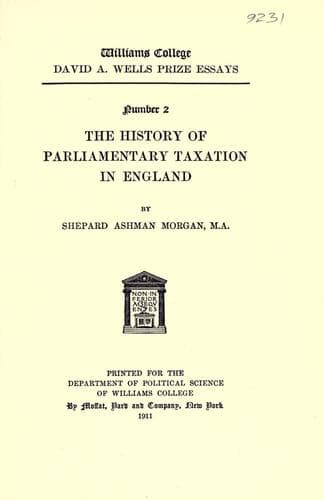
The History of Parliamentary Taxation in EnglandMorgan, Shepard Ashman
History
The History of Parliamentary Taxation in England
Morgan, Shepard Ashman
Taxation -- Great Britain; Taxation -- Great Britain -- History
The same year, 1198, furnishes us with what is by far the most
noteworthy and interesting incident of the reign of King Richard, an
event which is taken to be “a landmark of constitutional history.”[57]
Through his efficient justiciar, Archbishop Hubert Walter, the king
laid before his Council at Oxford a plan whereby he “required that
the people of the kingdom of England should find for him three hundred
knights to remain in his service one year, or else give him so much
money as to enable him therewith to retain in his service three hundred
knights for one year, namely three shillings per day, English money,
as the livery of each knight.”[58] The way in which Hubert Walter’s
proposition was met throws light upon the subservience of the National
Council. “While all the rest were ready to comply with this,” the
Chronicler proceeds, “not daring to oppose the king’s wishes, Hugh,
Bishop of Lincoln, a true worshipper of God, who withheld himself
from every evil work, made answer that for his part he would never in
this one matter acquiesce in the king’s desires.” Now, if it could
be established that the bishop raised the question as to whether
the king had a right to lay an imposition upon the baronage and to
require their assent, then we would be justified in saying that Hugh’s
refusal went far toward anticipating future history. But the evidence
does not uphold so generous an inference. In the first place, it
seems highly questionable whether Hubert Walter really offered the
alternative of a money payment,[59] a conclusion which reduces the
debate to one on foreign service. But Hugh even here did not raise the
general question. “I know,” he is quoted as saying, “that the see of
Lincoln is held by military service to our lord the king, but it has
to be furnished in this land alone; beyond the boundaries of England
nothing of the kind is due from it.”[60] Hugh, therefore, refused to
comply with the royal request on purely feudal grounds. Basing his
objection on ecclesiastical privilege, he registered his refusal for
the see of Lincoln alone; he did not take his stand in behalf of the
barons or even of the whole body of churchmen. The issue as to their
relative powers to tax was not raised between king and Council, and
the withdrawal of Hubert Walter’s demand did not constitute one of
the first victories over arbitrary taxation. The withdrawal itself
seems to have had its disagreeable consequences. Herbert, Bishop of
Salisbury, who stood shoulder to shoulder with Hugh of Lincoln in his
opposition, had to pay a heavy fine for his part in the contest, and
the Abbot of St. Edmund’s was obliged to win back royal favor with a
gift of a hundred pounds which he made in addition to the pay of four
knights for forty days.
Public-domain text, read in full here on John Shaqi.
Reviews
Reviews
No reviews yet
Be the first to share your thoughts on this work.
Join the Discussion
Join the discussion
Sign in to leave a comment or review.
Sign InorCreate an account