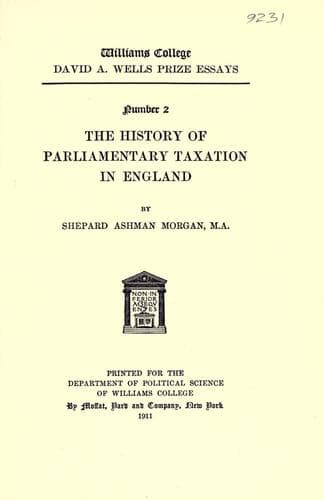
The History of Parliamentary Taxation in EnglandMorgan, Shepard Ashman
History
The History of Parliamentary Taxation in England
Morgan, Shepard Ashman
Taxation -- Great Britain; Taxation -- Great Britain -- History
Richard’s reign covered only a decade, six months of which he spent
in England.[61] Notwithstanding his long absence, during which the
National Council began in some small degree to feel itself able to
get along without the royal presence, the authority of the king as
the supreme initiator of taxation remained unquestioned. In the
assessing of taxes, however, the taxpayers had more participation.
The justiciars of Richard continued Henry II’s practice of assessment
through a representative jury.
[John, 1199-1216]
John, the youngest son of Henry II, the thinnest figure that ever
sat upon the English throne, succeeded to the crown some six weeks
after the tragic passing of Richard. Richard was the creation of his
own times, the incarnation of the mediæval spirit, and where it fell
short he fell short. To attribute the meanness of his brother to any
conditions of environment would be to perpetrate a slander upon the
times. Yet, notwithstanding the vileness of the king, there eventuated
from his reign the first of the three books in what Lord Chatham
denominated “the Bible of the English Constitution.” The progress
toward the finished writing of Magna Carta, especially in so far as the
events concern laying of taxes, is the next step in this history.
An interregnum of six weeks elapsed between the death of Richard and
the coming to England of John. Then Archbishop Hubert Walter set the
crown upon his head and declared him elected to the kingship. John’s
stay in England was necessarily brief, because Philip II of France was
already in a fair way to win his possessions on the far side of the
Channel. For his expedition into Normandy John exacted a scutage of two
marks on the knight’s fee; the rate was unusually high, almost without
precedent.
[John’s heavy taxation]
Being unable to make head against Philip, John concluded a truce for
which he had to pay 30,000 marks. The Jews had to pay a good deal of
it and in addition John took a carucage of three shillings on the
carucate, which, like the charge of scutage, was an exceedingly high
rate. John laid this imposition, apparently, solely upon his own
authority; Roger Hoveden says that he “took” the carucage and makes
no mention of a Council.[62] He demanded the aid, and the justices
issued the edicts. In 1201 John contributed, at the instance of a papal
delegate, a fortieth of his revenues for the Crusade; from his barons
he urged a similar offering, not “as a matter of right or of custom
or of compulsion.” Freeholders and tenants by knight’s service paid
at a similar rate; just what liberty they had in refusal is shown in
the direction of Geoffrey Fitz-Peter, the justiciar, at the end of
his address to the sheriffs: “And if any persons shall refuse to give
their consent to the said collection, their names are to be entered in
the register, and made known to us at London.”[63] In the same year he
exacted a scutage at the high rate of two marks on the knight’s fee.
Public-domain text, read in full here on John Shaqi.
Reviews
Reviews
No reviews yet
Be the first to share your thoughts on this work.
Join the Discussion
Join the discussion
Sign in to leave a comment or review.
Sign InorCreate an account