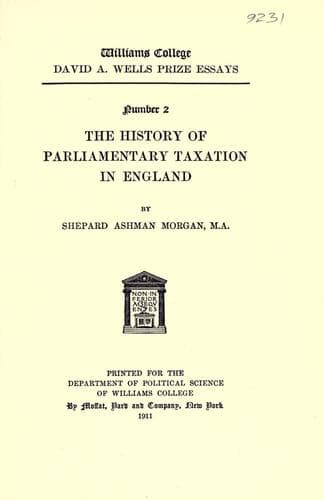
The History of Parliamentary Taxation in EnglandMorgan, Shepard Ashman
History
The History of Parliamentary Taxation in England
Morgan, Shepard Ashman
Taxation -- Great Britain; Taxation -- Great Britain -- History
MAGNA CARTA brought to an end the period of absolutism and prepared
the way for the control by Parliament of the taxing power. The barons,
standing for the moment as the champions of the nation, had wrung from
John the first concession. It really was not as great a concession, in
so far as the power to tax was concerned, as eager advocates of popular
rights have maintained. But it was the protest by the most influential
body in the kingdom and in effect by the nation itself against
unrestrained use of power by a royal tyrant.
[The reign of Henry III, 1216-1272]
The long reign of Henry III, stormy and contradictory to itself,
accomplished one clear step forward. From one cause or another it
became customary for the National Council, which in this reign first
attained to the title of Parliament, to grant money to the king.
Another step, of vast importance in the later history of parliamentary
taxation, but in Henry’s time probably not of intimate connection with
it, was the summons of the lesser tenants and subsequently of the
townsmen into the councils of Parliament. There is no sure record that
in Henry III’s reign a Parliament so constituted voted taxes, yet it
is apparent that this differentiation in the national legislative body
was the preliminary of the vesting of the taxing power in the House of
Commons.
[Reissue of the Charter with omissions]
John died in the midst of his reverses the 19th October, 1216. The
major part of his vassals were in the field against him, and worse
than all, Louis, the heir to France, with French soldiers at his back,
was in England at the bidding of the English baronage. Nine days after
John’s death, his son Henry, a nine-year-old lad, was crowned King of
England with small ceremony. After a lapse of two weeks, on the 11th
November, a body of barons gathered at Bristol. There were four or
five earls, including Pembroke, Chester, and Derby; eleven bishops,
Hubert de Burgh, one or two other ministers, and some of the military
leaders. Only one of the executors of the Charter figured at the
meeting and this was William of Aumâle. For the most part they were of
the party least disaffected by John; the rabid opponents of the old
King were in the body of supporters around Louis of France. The Council
proceeded to appoint William Marshal, Earl of Pembroke _Rector regis et
regni_, being unwilling to elect a relative of the young King to this
responsible position. The next day they reissued the Charter by common
consent in the King’s name, with the important omission of Chapters
Twelve and Fourteen.
Public-domain text, read in full here on John Shaqi.
Reviews
Reviews
No reviews yet
Be the first to share your thoughts on this work.
Join the Discussion
Join the discussion
Sign in to leave a comment or review.
Sign InorCreate an account