The History of Parliamentary Taxation in England — John Shaqi
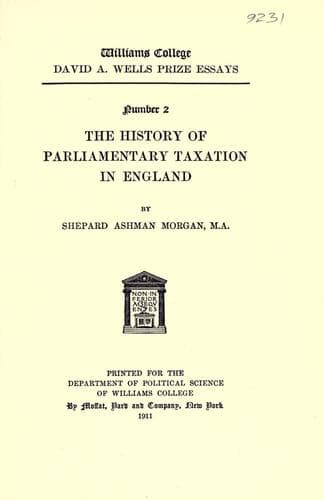
The History of Parliamentary Taxation in EnglandMorgan, Shepard Ashman
History
The History of Parliamentary Taxation in England
Morgan, Shepard Ashman
Taxation -- Great Britain; Taxation -- Great Britain -- History
It is a conclusion easily drawn from the text of the two chapters
that this was a body of feudatories called together for the purpose
of making feudal payments. The members of the Commune Concilium were
the vassals of the crown and, save in rare instances, none other;
the taxation to which they were to give their consent according to
the terms of the Charter, included no carucage or other general tax,
but only the scutages and aids which feudal tenants of the king by
military service were expected to pay him as overlord. Furthermore,
the idea of representation in the strictly technical sense into which
present usage has frozen the word, was quite wanting. It is true that a
consent by the barons gathered in the Council to an imposition levied
in accordance with the notice stated in the summons, was binding upon
the barons who did not attend, but this was on the principle that
absence gave consent, not that the consent of the majority was binding
upon a dissentient minority. The instance is quoted of the Bishop
of Winchester who in Henry III’s time was relieved of his assessment
because he had opposed the levy in the Council. John had introduced
definite representation in his summons to the Oxford Council in 1213,
by directing the sheriffs to send up “four discreet knights” from their
counties to treat with him “concerning the business of his realm.” In
respect of this, looking at it in the light of later progress, the
Great Charter is positively retrogressive.
The conclusion is thus forced upon us that save in the two cases of
scutages and extraordinary aids, with possibly the addition of a
third in the shape of tallaging the city of London, supreme authority
over general taxation remained in the hands of the king. The Charter
provides solely for the financial incidents of the feudal relation,
and that in the somewhat narrower aspect of tenure by chivalry. The
only true taxes, carucage and John’s levy on movables known as the
thirteenth, were not referred to. It is an anticipation of later
history to read into the provisions of Magna Carta either a definite
inauguration of national consent to taxation or of the representative
principle.
But the wedge was driven in. Notwithstanding the omission of both
the Twelfth and the Fourteenth Chapters in subsequent renewals of
the Charter, the king lived up to the principles therein set down;
and notwithstanding the absence in Magna Carta of provision for
parliamentary taxation in fact, it was there in embryo. The nation,
headed by the barons, had set itself to the correction of abuses, and
it succeeded in attaining its immediate end. Greater purposes were to
follow, born perhaps of the inspiration in the Charter, and with the
purposes were to come also the means of attaining them. The nation,
having once taken a sip of the cup of control over taxation, would not
be content until at last it had drunk deep from the well itself.
III
THE CUSTOM OF PARLIAMENTARY GRANTS
1215-1272
Public-domain text, read in full here on John Shaqi.
Reviews
Reviews
No reviews yet
Be the first to share your thoughts on this work.
Join the Discussion
Join the discussion
Sign in to leave a comment or review.
Sign InorCreate an account