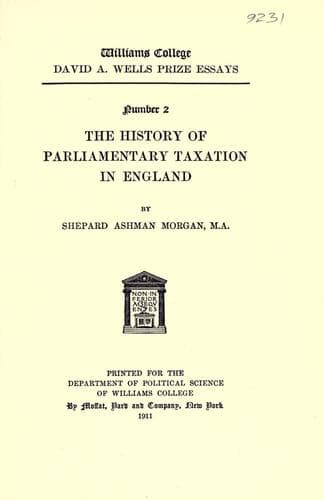
The History of Parliamentary Taxation in EnglandMorgan, Shepard Ashman
History
The History of Parliamentary Taxation in England
Morgan, Shepard Ashman
Taxation -- Great Britain; Taxation -- Great Britain -- History
[Text of 1215 is adhered to in practice]
But the future was fairer than the conditions presaged. As a matter of
fact, the king observed in the majority of instances the conditions
imposed by the Charter of John. Scutages of even less amount than
those “taken in the time of King Henry” were taken with the consent of
the National Council, the sessions of which “continued as from time
immemorial,” though the provisions for its summons had been laid aside.
That the barons were intending to retain control as under the Charter
is indicated by the fact that a scutage under the date 24th January,
1218, “was assessed by the common council of our realm.”[87] Bishop
Stubbs believes that this scutage was granted by the identical Council
which reissued the Charter the previous November.[88] Furthermore,
there is a note of a carucage under the date 9th January, 1218, which
“was assessed by the council of our realm,” a remark which suggests
that not only did this Council determine to grant feudal payments of
scutage, but assumed as well the power of registering its assent to a
general land tax.
[Carucage “assessed” by the Council, 1218]
If full credence can be attached to the record here given that a tax
was “assessed” by the Council, and if the act of assessment can be
taken as indicating, so to speak, full-fledged consent on the part of
the barons, then we have in this record of the Close Rolls one of the
very earliest instances of general taxation by and through the English
National Council. That no greater attention was given to the event than
the scant sentence in the Rolls, is perhaps not to be wondered at,
considering the youth of the king and the coherent Council.
With such a Council, bent apparently upon putting in practice greater
privileges than it had given itself in theory, the boy Henry began his
long reign. The good Earl of Pembroke died in 1219 and Henry was left
to the conflicting counsels of Hubert de Burgh and Peter des Roches,
the Bishop of Winchester. Growing restive under them at last, in 1223
he secured a declaration from the Pope that he was of age, he being
then sixteen, and swore to observe the Charters. But neither of his
reissues of the Charter could be called, strictly speaking, voluntary;
and liberties extorted, in the sinister words of the sycophant William
Briwere, “ought not by right to be observed.”[89] The uneasiness
arising out of this uncertain state of the Charters, led to one of the
first instances of a grant of money on condition that grievances be
redressed, a manner of grant which served the Commons many a turn in
their subsequent struggles with royal prerogative.
[Conditional grant of a fifteenth of movables, 1224]
Public-domain text, read in full here on John Shaqi.
Reviews
Reviews
No reviews yet
Be the first to share your thoughts on this work.
Join the Discussion
Join the discussion
Sign in to leave a comment or review.
Sign InorCreate an account