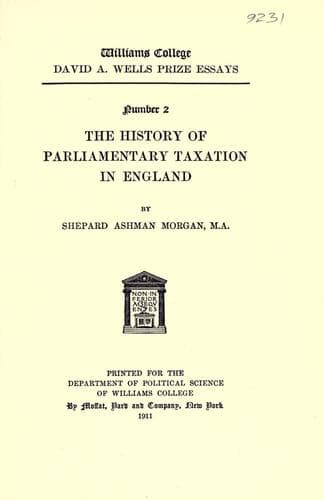
The History of Parliamentary Taxation in EnglandMorgan, Shepard Ashman
History
The History of Parliamentary Taxation in England
Morgan, Shepard Ashman
Taxation -- Great Britain; Taxation -- Great Britain -- History
In 1224 war was on with Philip II for the possession of Poictou. The
taxation which had not been severe up to this time, was insufficient
for the prosecution of a war with France.[90] The justiciar at the
Christmas Council 1224 brought forward a demand for a fifteenth of
all movables.[91] The barons, acting beyond the power which even the
Charter of John had given them, refused to consent, unless Henry should
“of his own natural and good will” renew Magna Carta. He yielded, and
reissued both the Charter of Liberties and the Charter of the Forests
in practically the same form as the issue of 1217. That the reissue
partook of the nature of a contract between the barons and the king is
evinced in the concluding portion of the Charter itself.[92] There it
is openly stated that “the archbishops, bishops, abbots, priors, earls,
barons, knights, freeholders, and all persons of the realm, give the
fifteenth part of all movables to the king,” “for this concession and
granting of liberties.”
Here is an unequivocal instance of a tax on movables, applying to
every person in the kingdom from the archbishops and great nobles
down, granted explicitly by the Council in return for Henry’s specific
promise to adhere to the Charter. It was the most natural thing in the
world, that the barons should demand a favor in return for granting
one. They had Henry in a box and his acquiescence is none the less
natural. Yet the action is of great importance in view of later
developments. Time and time again the situation was to be repeated, and
out of repetition was to come usage which would be frozen into law. It
is of vast interest, therefore, to note the appearance so early of the
conditional grant.
[Other conditional grants and instances of refusal]
The Council continued to exercise the right not merely of making grants
of money in consideration of a redress of grievances, but also of
refusing to make a grant at all, whenever such a stand suited their
convenience. In 1232 the Earl of Chester, being spokesman for the
barons, objected to a request for money with which to carry on the
French war, on the plea that they had served in person; the clergy
sought postponement, raising the significant plea of an incomplete
assembly of prelates.[93]
[Offer of a disbursing commission, 1237, rejected]
Public-domain text, read in full here on John Shaqi.
Reviews
Reviews
No reviews yet
Be the first to share your thoughts on this work.
Join the Discussion
Join the discussion
Sign in to leave a comment or review.
Sign InorCreate an account