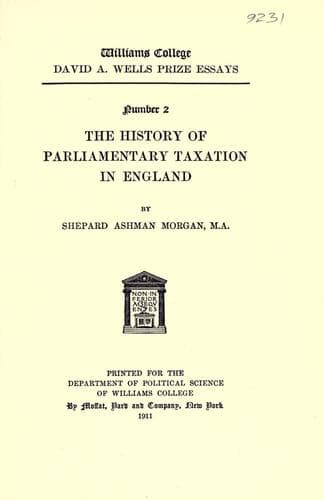
The History of Parliamentary Taxation in EnglandMorgan, Shepard Ashman
History
The History of Parliamentary Taxation in England
Morgan, Shepard Ashman
Taxation -- Great Britain; Taxation -- Great Britain -- History
An account of the advance toward the laying of taxes by representatives
of the people must begin with some notice of the idea of taxation which
actuated the German tribesmen. Tacitus writing of them as they were at
the beginning of the Second Century A. D. makes this remark: “It is
customary amongst the states to bestow on the chiefs by voluntary and
individual contribution a present of cattle or of fruits, which, while
accepted as a compliment, supplies their wants.”[1] Here, then, is the
earliest idea of a tax, a voluntary contribution for the support of the
_princeps_. It was prompted by the essentially personal relationship
existent between people and chieftain, the sense of attachment of the
people to the leader. Direct taxation laid by the _princeps_ upon the
tribe, was as unknown in Germany as it was foreign to the Germanic
spirit.
[Amongst the Anglo-Saxons]
When the conquering Saxons, therefore, swept westward across the
German Ocean, they carried with them scarcely more than a semblance
of taxation. Between men and leader the personal relationship still
subsisted, but as time went on, the Anglo-Saxon king became less
the father of the people, and more their lord. Lord of the national
land he was as well, but he did not rule by reason of that fact. The
two claims upon popular support were therefore distinct, the one as
personal leader, the other as lord of the national land; and during the
major part of the Anglo-Saxon era they afforded a sufficient means for
the maintenance of the king and his government. Until the moment of a
supreme emergency the king did not have to seek extraordinary sources
of income.
[Revenue of the Anglo-Saxon kings]
As lord of the national land, the king had a double source of revenue.
The folkland, or land subject to national regulation[2] and alienable
only by the consent of the Witenagemot, presented the king with its
proceeds, much of which went for the maintenance of the royal armed
retainers and servants. Deducible from this right to the public lands,
was the claim of the king to tolls, duties, and customs accruing from
the harbors, landing-places, and military roads of the realm, and
to treasure-trove. Aside from this, the king was one of the largest
private landowners in the kingdom, and from it he derived rents and
profits which were disposable at will.
Public-domain text, read in full here on John Shaqi.
Reviews
Reviews
No reviews yet
Be the first to share your thoughts on this work.
Join the Discussion
Join the discussion
Sign in to leave a comment or review.
Sign InorCreate an account