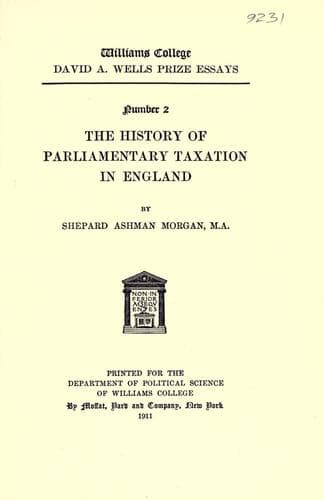
The History of Parliamentary Taxation in EnglandMorgan, Shepard Ashman
History
The History of Parliamentary Taxation in England
Morgan, Shepard Ashman
Taxation -- Great Britain; Taxation -- Great Britain -- History
Divine right as against Parliamentary supremacy--James I
dictates the composition of the House of Commons--Tunnage and
poundage for life--Royal poverty--The Bate Case--Opinions of
the Barons in the Bate Case--The position of Parliament--The
Book of Rates--Remonstrance from the Commons--Cowel’s
“Interpreter”--The Great Contract--Petty extortion after the
dissolution of Parliament--The “Addled” Parliament--Case
of Oliver St. John--James’s Third Parliament--Delay
of a supply pending redress of grievances--Revival of
impeachment by the Commons--James’s last Parliament--Charles
I--His early Parliaments--Forced loans--Threats of
non-Parliamentary exaction--The Petition of Right--Omission
of the customs--Tunnage and poundage--Charles’s eleven
years without Parliament--His financial expedients--Ship
Money--Extra-judicial opinions--Hampden’s Case--Judgment for
the Crown--The Short Parliament--The Long Parliament--Royal
exaction of tunnage and poundage declared illegal--The
Ship Money Act--The Grand Remonstrance--The Puritan
Revolution--Charles II--Appropriation of Supplies--James
II--William and Mary--The Bill of Rights.
INDEX 309
PARLIAMENTARY TAXATION
I
THE SAXONS: CUSTOMARY REVENUES AND EXTRAORDINARY CONTRIBUTIONS
[Evolutionary character of the English Constitution]
THE English Constitution looks ever backward. Precedent lies behind
precedent, law behind law, until fact shades off into legend and that
into a common beginning, the Germanic character. Standing upon the
eminence of 1689, one sees the Petition of Right, and then in deepening
perspective, Confirmatio Cartarum and Magna Carta. The crisis of 1215
points to the Charter of Henry I, and behind that are the good laws of
Edward the Confessor. The Anglo-Saxon polity looks back of the era of
Alfred, to the times when Hengist and Horsa were yet unborn, and the
German tribesmen were still living in their forests beyond the Rhine
without thinking of migrating westward. And there, behind the habits of
those barbaric ancestors of Englishmen, lies the national character,
the Anglo-Saxon sense of right and wrong, of loyalty, justice, and
duty. The growth of the English Constitution has been as subject to
the laws of evolution as the development of man himself. The germ of
national character evolved habits of thought and action, and these
habits, or as they are better termed, institutions, were beaten upon by
conditions and fused with the institutions of another people, until at
last they took on the shape of free government.
[Early ideas of taxation]
[Amongst the Germans]
Public-domain text, read in full here on John Shaqi.
Reviews
Reviews
No reviews yet
Be the first to share your thoughts on this work.
Join the Discussion
Join the discussion
Sign in to leave a comment or review.
Sign InorCreate an account