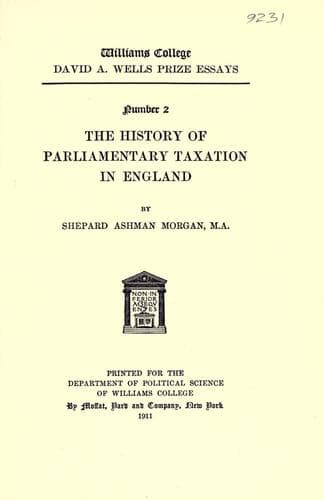
The History of Parliamentary Taxation in EnglandMorgan, Shepard Ashman
History
The History of Parliamentary Taxation in England
Morgan, Shepard Ashman
Taxation -- Great Britain; Taxation -- Great Britain -- History
When Edward I put his name to Confirmatio Cartarum at Ghent, on
the 5th November, 1297, he had still ten years to live. In 1301, he
re-confirmed the Charters in a bill of some twelve articles forced
from him by the barons in a manner which he denounced as outrageous,
and thereby concluded the baronial conflict. The barons presented
their claims at the Parliament of Lincoln which was summoned for the
20th January, 1301, and included amongst them, beside the plea for a
confirmation of the Charters, a demand for the enforcement of general
reforms, this last to be the prerequisite for a grant of money. A
fifteenth of all movables was then voted to the king, to be paid upon
the completion of the reforms, the date proposed being Michaelmas next
coming.[188] The clergy, who still professed adherence to the bull
“Clericis laicos,” with the approval of the baronage averred that
they could not acquiesce in any grant of money in the face of papal
prohibition. Edward, in his reply to the claims made by the barons,
declared his unwillingness to admit the validity of the assertion that
papal consent was necessary to the clerical grant. His confirmation of
the Charters was dated 14th February, 1301.[189]
[Edward’s financial expedients]
[Tunnage and poundage and other customs]
Edward’s last years were years of financial difficulty. In 1302 at the
Parliament held on the 1st July, at London, he received from the lay
estates and the clergy a fifteenth of temporal goods.[190] The same
year saw him turn back to the aid _pur fille marier_ which the barons
had granted twelve years previously in June, 1290; and in 1303 he
attempted to obtain the consent of the merchants to an increase in the
custom on wine, wool, and merchandise. He called a meeting at York,
quite irregular in its constitutional aspect, and presented the matter
for its consideration. The merchants would not listen to the plea and
the matter, as far as denizens were concerned, was dropped.[191] Five
months previously, on the 1st February, Edward had had better fortune
in a similar effort with the foreign merchants. On the principle that
the crown had the right to close the ports to merchant strangers,
Edward entered into negotiation with the leading men amongst them, and
in return for a grant of all the privileges and liberties essential to
them, they agreed to a fifty per cent. increase over the rates paid
upon wools and leather by English-born merchants. Beside these were new
duties upon other commodities, whether they be exported or imported:
wine, 2_s._ on the tun, a custom which was to achieve notoriety
under the name of tunnage; cloth, from 1_s._ to 2_s._ on the piece
depending upon the dye; general merchandise, 3_d._ in the pound of
20_s._, subsequently called poundage; and wax, 1_s._ per quintal.[192]
This agreement between king and merchants, known by the title “Carta
Mercatoria,” was not technically in contravention of Confirmatio
Public-domain text, read in full here on John Shaqi.
Reviews
Reviews
No reviews yet
Be the first to share your thoughts on this work.
Elsewhere in the archive
Join the Discussion
Join the discussion
Sign in to leave a comment or review.
Sign InorCreate an account