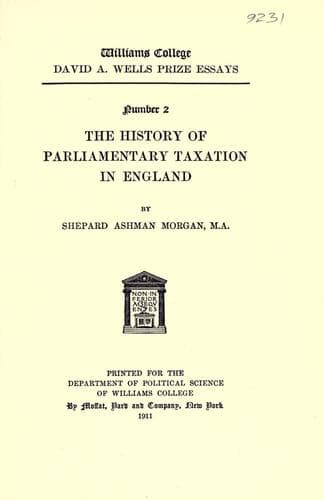
The History of Parliamentary Taxation in EnglandMorgan, Shepard Ashman
History
The History of Parliamentary Taxation in England
Morgan, Shepard Ashman
Taxation -- Great Britain; Taxation -- Great Britain -- History
Cartarum, notwithstanding the provisions of the latter against the
levying without national consent of any but the “ancient prises” and
the custom on wool previously granted. Confirmatio Cartarum was a grant
to Englishmen and to Edward’s sharply legal mind, its liberties did not
extend to foreigners, however closely knit their relations might be
with the king’s own people.
[Tallage, 1304]
In 1304 Edward took from the demesne cities and boroughs and the royal
demesne a sixth of movables.[193] The records of the Parliament of
1305, far from noting any complaint against the king’s tallage, contain
this memorandum: “To the petition of archbishops, bishops, prelates,
earls, barons, and other good men of the land, praying that the king
wills to grant them the power to tallage their ancient demesne ... even
as the king has tallaged his demesne, it was answered, ‘Let it be as
petitioned.’”[194] This is all but final evidence against the validity
of _De tallagio non concedendo_.[195]
[Edward II, 1307-1327]
The great Edward died at Burgh-upon-Sands on Friday, the 7th July,
1307, and the sceptre fell into the nerveless hand of Edward II. The
new king did not inherit his father’s great attributes nor his good
fortune; he was improvident and unperceptive, the faithful dupe of
advantage-seeking associates, the lavish spender of money he did not
have, the chief enemy of himself. At last, when he had reigned some
twenty years, he was put down and his son succeeded in his stead.
Edward II’s accession was undisputed; at Carlisle, on the 20th July, he
received the homage and fealty of the English baronage, and six months
later on the 25th February, 1308, he was crowned. The coronation oath
he was obliged to take in French, not being familiar with the Latin
tongue. The oath was more than usually stringent; the last of the four
promises required of the king was this: “Sire, do you grant to hold
and to keep the laws and righteous customs which the community of your
realm shall have chosen, and will you defend and strengthen them to the
honor of God, to the utmost of your power?” Edward answered, “I grant
and promise.”[196]
Edward did not call a Parliament between
October 1307, and April 1309.[197] He was in fear, apparently, of an
attack upon his foreign favorite, Piers Gaveston, and was desirous
of shielding him, as Charles I attempted to shield Buckingham three
centuries later, by doing without a Parliament. The only merit of
the favorite seems to have been the deep, and in its consequences
the pathetic love with which he inspired the young monarch. He was
self-seeking, avaricious, willful, and capable of exercising a
domination over the king as complete as it was profitable to himself.
At last, however, the loans, which his Italian bankers, the Friscobaldi
had supplied Edward, withered away and he was obliged to issue a
summons to a Parliament.
[Tentative abolition of the New Customs]
Public-domain text, read in full here on John Shaqi.
Reviews
Reviews
No reviews yet
Be the first to share your thoughts on this work.
Elsewhere in the archive
Join the Discussion
Join the discussion
Sign in to leave a comment or review.
Sign InorCreate an account