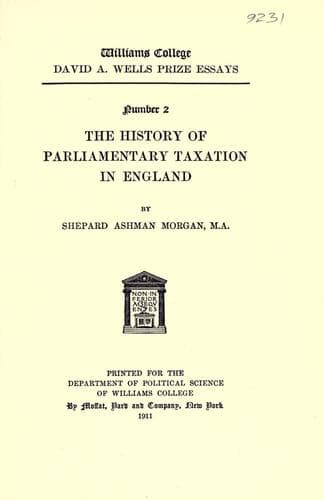
The History of Parliamentary Taxation in EnglandMorgan, Shepard Ashman
History
The History of Parliamentary Taxation in England
Morgan, Shepard Ashman
Taxation -- Great Britain; Taxation -- Great Britain -- History
Parliament met on the 27th April, 1309, with a full attendance of
clergy, lords, knights and burgesses. In response to Edward’s urgent
request for funds, the lords, burgesses and knights granted him a
meagre twenty-fifth, but only on condition of a redress of grievances,
these being detailed in a schedule of eleven articles.[198] Two of
the eleven have to do with taxation; the first was directed at the
abuses of purveyance; the second hit more nearly, having to do with the
New Customs which Edward I had provided for in the Carta Mercatoria
of 1303.[199] “And as to the customs which the king taketh by his
officers--,” so goes the memorandum in the Rolls, “that is to say, of
every tun of wine, two shillings; of every cloth which alien merchants
bring into his land, two shillings; and of every pound value of avoir
de pois, three pence--the king willeth at the request of the said good
people that the said customs of wines, clothes, and avoir de pois, do
cease at his will, in order to know and be advised what profit and
advantage will accrue to him and his people by ceasing the taking
of those customs; and the king will have counsel according to the
advantage which he shall see therein: saving always to the king the
ancient prises and customs anciently due and approved.” The king gave
orders that the conditional grant of the twenty-fifth be collected.
[The Lords Ordainers, 1309-1311]
The trouble over Gaveston, however, was not settled, and he became
increasingly worrisome to the barons. Furthermore the customs were
collected not by Englishmen but by Edward’s Italian bankers. In March
1310, meeting in council, the barons drew up a petition praying against
the impoverishment of the exchequer despite grants of money; the king,
so they said, was still exacting prises and living by purveyance
contrary to the engagement of 1309. Edward, still hoping to shield
Gaveston, assented to the election of a commission of twenty-one, known
as the Lords Ordainers, who exercised his authority for the space of a
year and a half.
Public-domain text, read in full here on John Shaqi.
Reviews
Reviews
No reviews yet
Be the first to share your thoughts on this work.
Elsewhere in the archive
Join the Discussion
Join the discussion
Sign in to leave a comment or review.
Sign InorCreate an account