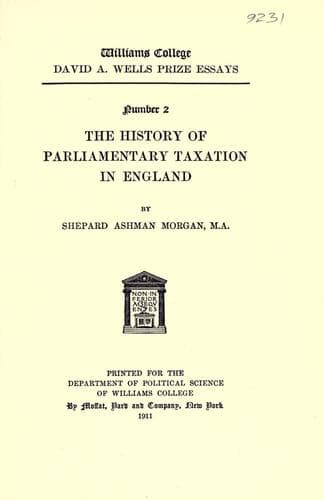
The History of Parliamentary Taxation in EnglandMorgan, Shepard Ashman
History
The History of Parliamentary Taxation in England
Morgan, Shepard Ashman
Taxation -- Great Britain; Taxation -- Great Britain -- History
The Lords Ordainers, recalling in their composition and purposes those
who put forward the scheme of reform in the Provisions of Oxford of
1255, proceeded to promulgate ordinances for the correction of abuses.
On the 2d August, 1310, six ordinances were made public and received
the confirmation of the king.[200] By the fourth, it was ordained “that
the customs of the realm be kept and received by people of the realm,
and not by aliens; and that the issues and profits of the same customs,
together with all other issues and profits of the realm arising from
any matters whatsoever, shall come entirely to the King’s exchequer,
... to maintain the household of the king, and otherwise to his profit,
so that the king may live of his own, without taking prises other than
those anciently due and accustomed; and all others shall cease.”[201]
Despite the apparent inclusion of the “New Customs” within the meaning
of this ordinance, their resumption was ordered the same day, on the
ground that during the period of their prohibition, prices had not been
reduced.[202]
[New Customs abolished]
Parliament met on the 8th August, 1311, to receive the final report of
the Ordainers, and sat for two months. Thirty-five additional articles
were drawn up in Parliament.[203] By the tenth article new prises
are to be abolished, and by the eleventh the New Customs are done
away with in their entirety. “New customs have been levied,” says the
ordinance, “and the old enhanced, as upon wools, cloths, wines, avoir
de pois, and other things, whereby the merchants come more seldom, and
bring fewer good into the land, and the foreign merchants abide longer
than they were wont to do, by which abiding things become more dear
than they were wont to be, to the damage of the king and his people;
we do ordain that all manner of customs and imposts levied since the
coronation of King Edward, son of King Henry, be entirely put out, and
altogether extinguished for ever, notwithstanding the charter which the
said King Edward made to the merchant aliens, because the same was made
contrary to the Great Charter ..., saving nevertheless to the king the
customs of wools, woolfells, and leather; that is to say, for each sack
of wool, half a mark, and for three hundred woolfells, half a mark, and
for a last of leather, one mark ..., and henceforth merchant strangers
shall come, abide, and go according to the ancient customs....”[204] On
the 9th October, the day upon which Parliament rose, the order went
out which made the ordinance effective.[205]
[Banishment of Gaveston]
[Tallage of 1312: Riots in London and Bristol]
Public-domain text, read in full here on John Shaqi.
Reviews
Reviews
No reviews yet
Be the first to share your thoughts on this work.
Elsewhere in the archive
Join the Discussion
Join the discussion
Sign in to leave a comment or review.
Sign InorCreate an account