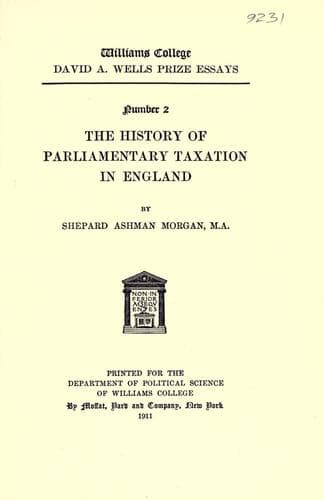
The History of Parliamentary Taxation in EnglandMorgan, Shepard Ashman
History
The History of Parliamentary Taxation in England
Morgan, Shepard Ashman
Taxation -- Great Britain; Taxation -- Great Britain -- History
Gaveston, the hated favorite, whose corruption and acts of oppression
had furnished the immediate cause for the reform movement, was amply
provided for. He was put under sentence of perpetual banishment and
in order to safeguard themselves against the return to power of him
and his kind, the barons reiterated the demand made in 1244, that the
appointment of ministers be subject in the future to their council
and consent.[206] The king gave his assent to the ordinances on the
30th September and two weeks later they went out to the sheriffs for
publication.
The Parliament which met in 1312 granted Edward no money. His position
was desperate and he turned everywhere in the hope that he could raise
funds wherewith to meet his necessities; the merchants and the clergy,
even the Pope, were induced to lend him money. But they could not
satisfy his needs; therefore in December, 1312, the Council determined
to levy a tallage on the demesne towns and the royal demesne of a
fifteenth of movables and a tenth of rents.[207] The imposition met
with opposition, resistance being most riotous in London and Bristol.
The objections which the people of Bristol raised were not based upon
legal grounds; it so happened that at the moment certain of their
burgesses were confined in the Tower of London, and that grievance,
so they maintained, warranted their refusal. The basis for resistance
raised by the citizens of London was not so casual; they claimed
immunity from a royal tallage on the ground of the “ancient privileges”
guaranteed to them under Magna Carta. Neither cited _De tallagio non
concedendo_ as the defense of their actions, and the presumption
against the validity of the so-called statute is therefore enhanced.
The king secured his payment by way of compromise; the Londoners
granted a “loan” of £400 and another of £1000, from which sums they
were to be relieved at the time of collection of the next general
aid. Many other towns escaped upon the ground that they were not
situated within the royal demesne. The principle that the king could
levy tallages upon his own demesne thus remained unquestioned; but no
tallage was levied during the rest of this reign.[208]
[Deposition of Edward II]
It is unnecessary to follow Edward II to his melancholy end. His
deposition came more as the result of stress in his own household than
because of any strain which he put upon the constitution. Favorites,
an unfaithful wife, and factions which he bred among his barons, did
more to bring about his dethronement and his subsequent murder than any
condition of taxation. In the list of grievances which Bishop Stratford
drew up as furnishing cause sufficient for the overthrow of Edward,
nothing appears which has any connection with the question of taxation,
much less any assertion of parliamentary right to control it. The king
consented to the election of his son in his stead on January 20, 1327.
Eight months thereafter he died; few doubt that he was murdered.
Public-domain text, read in full here on John Shaqi.
Reviews
Reviews
No reviews yet
Be the first to share your thoughts on this work.
Elsewhere in the archive
Join the Discussion
Join the discussion
Sign in to leave a comment or review.
Sign InorCreate an account